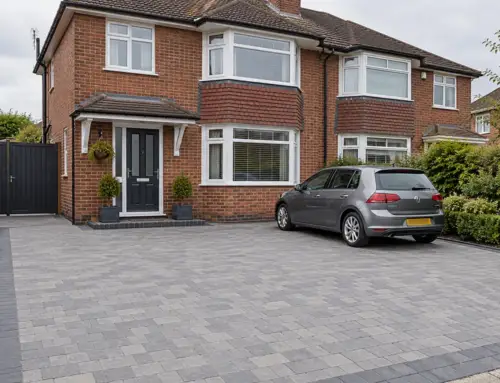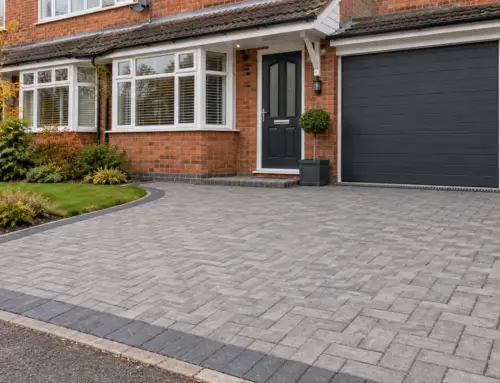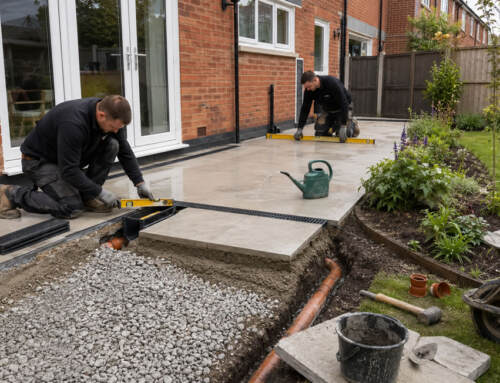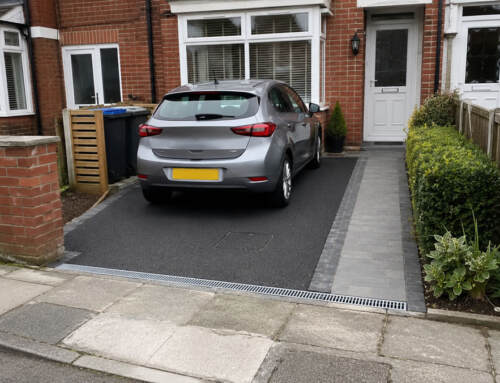


For most UK driveways, asphalt is cheaper than paving slabs.
A straightforward asphalt driveway will usually cost less to install because the surface material is relatively economical and it can be laid quickly over a properly prepared base. Paving slabs take longer to install because every slab needs positioning, levelling, cutting and jointing.
However, the difference is not always enormous.
If you compare asphalt with basic vehicle-rated concrete paving, the gap may be fairly modest. If you compare asphalt with premium porcelain, sandstone or granite driveway slabs, asphalt can be substantially cheaper.
The size of the driveway also matters. Asphalt tends to become more cost-effective as the area increases because machinery, transport and hot-material delivery costs can be spread across more square metres.
For a small driveway, those fixed costs can make asphalt surprisingly expensive per square metre.
So, while asphalt usually wins on initial price, the complete answer depends on:
- Driveway size
- Existing surface
- Ground conditions
- Slab type
- Drainage
- Edging
- Access
- Vehicle loading
- Desired appearance
This guide compares asphalt and driveway paving slabs in detail, including installation costs, groundwork, maintenance, repairs and long-term value.
Asphalt vs Paving Slabs at a Glance
| Feature | Asphalt | Driveway Slabs |
|---|---|---|
| Typical installation cost | Lower | Higher |
| Installation speed | Faster | Slower |
| Labour requirement | Lower | Higher |
| Appearance | Simple | Premium |
| Colour choice | Limited | Extensive |
| Maintenance | Low | Low to moderate |
| Weed growth | Very low | Possible in joints |
| Local repairs | Easy but visible | Individual slabs can often be replaced |
| Curved areas | Very good | More cutting required |
| Small driveways | Good | Good |
| Large driveways | Very cost-effective | Can become expensive |
| Permeable options | Porous asphalt available | Permeable systems available |
| Heavy vehicles | Good with suitable construction | Product must be vehicle-rated |
How Much Does an Asphalt Driveway Cost?
Current UK price guides commonly put a straightforward new asphalt or tarmac-style driveway somewhere around £70–£110 per m², with around £90 per m² being a useful broad benchmark for an average installation.
Other recent UK pricing data gives a wider installed range of roughly £45–£100 per m², reflecting the difference between simple sites and jobs requiring more excavation, drainage or preparation.
For budgeting, a useful general range is:
Around £60–£100 per m² for many straightforward asphalt driveway installations.
However, very small jobs may cost more per square metre.
How Much Do Driveway Slabs Cost?
This depends much more heavily on the paving chosen.
Vehicle-rated paving might include:
- Concrete driveway slabs
- Large-format concrete paving
- Specialist driveway porcelain
- Sandstone
- Granite
- Natural stone setts
Broad installed prices might look like:
| Driveway Paving | Typical Installed Cost |
| Basic concrete paving | £80–£120 per m² |
| Better-quality concrete slabs | £90–£140 per m² |
| Decorative driveway slabs | £100–£160 per m² |
| Natural stone | £120–£200+ per m² |
| Driveway porcelain | £130–£220+ per m² |
| Granite | £140–£250+ per m² |
For comparison, current UK block-paving guides commonly place mainstream paved driveways around £90–£130 per m², while natural stone materials cost considerably more.
Therefore, asphalt will usually be the cheaper choice.
Example Cost Comparison
Imagine a straightforward 40m² driveway.
Asphalt
At roughly £70–£100 per m²:
£2,800–£4,000
Concrete Driveway Slabs
At roughly £90–£140 per m²:
£3,600–£5,600
Premium Driveway Porcelain
At roughly £130–£220 per m²:
£5,200–£8,800
That means the difference can become substantial once premium paving is selected.
Why Is Asphalt Usually Cheaper?
There are several reasons.
1. It Can Be Installed Quickly
Once the base is prepared, asphalt can cover a relatively large area quickly.
A paving installer needs to:
- Carry individual slabs
- Spread bedding
- Position each slab
- Check levels
- Cut edges
- Maintain joint widths
- Point or joint the finished surface
That adds considerably more labour.
2. Slabs Cost More to Buy
Standard asphalt aggregate and binder generally cost less than quality decorative paving.
Premium products such as:
- Porcelain
- Granite
- Natural sandstone
can be several times more expensive per square metre than asphalt surfacing material.
3. Slab Installation Requires More Skilled Finishing
The visible surface depends on careful setting out.
A good paved driveway needs:
- Straight lines
- Consistent joints
- Accurate falls
- Neat cuts
- Level slabs
Poor workmanship is immediately noticeable.
4. Paving Produces More Cutting Waste
Driveways are rarely perfect rectangles.
Contractors may need to cut around:
- Walls
- Curves
- Drain covers
- Gates
- Paths
- Steps
With expensive paving, this creates material waste.
Asphalt simply follows the shape.
Does Asphalt Always Cost Less?
No.
There are situations where the price difference becomes smaller.
For example:
- Very small driveway
- Expensive asphalt delivery
- Restricted machinery access
- Existing base already suitable for paving
- Cheap concrete blocks or slabs selected
On a tiny 15–20m² area, asphalt contractors may still need to bring:
- Crew
- Roller
- Compactor
- Hot asphalt
- Transport
Those fixed costs can push up the rate.
Why Small Asphalt Driveways Cost More Per Square Metre
Suppose two jobs use identical equipment.
Job A
20m² driveway.
Job B
100m² driveway.
The contractor still needs to:
- Travel to site
- Bring machinery
- Arrange hot material
- Pay workers
With the larger job, those costs are spread across five times as much surface.
Asphalt therefore tends to become increasingly competitive as driveway size grows.
What Counts as a Driveway Slab?
This is important because not every patio slabs are suitable for cars.
Driveway slabs need to withstand:
- Vehicle weight
- Wheel loading
- Braking
- Turning forces
- Stationary steering
An attractive 20mm patio slab may not be suitable unless the manufacturer specifically approves the complete system for vehicle use.
Common Driveway Slab Materials
Concrete
Usually the cheapest slab option.
Advantages include:
- Good strength
- Wide range of colours
- Predictable sizing
Porcelain
Popular for modern homes.
Advantages include:
- Low water absorption
- Consistent colour
- Low maintenance
- Premium appearance
However, specialist driveway porcelain systems cost considerably more than ordinary asphalt.
Granite
Very strong and attractive.
It can last for decades but is:
- Expensive
- Heavy
- Labour-intensive
Sandstone
Some sandstone products are suitable for vehicle areas.
However, check the manufacturer’s specification rather than assuming patio paving can take cars.
Is Asphalt Cheaper Than Concrete Slabs?
Usually, yes.
However, basic concrete paving can sometimes come reasonably close.
For example:
- Asphalt: £70–£100 per m²
- Concrete paving: £80–£120 per m²
On a straightforward driveway, the difference may only be £10–£30 per m².
On 50m², that could still mean:
£500–£1,500 difference
Is Asphalt Cheaper Than Porcelain Driveway Paving?
Almost always.
Driveway-rated porcelain is a premium product.
The paving itself costs more, while installation also requires:
- More cutting
- Accurate laying
- Bedding
- Priming where specified
- Jointing
A porcelain driveway can easily cost twice as much as basic asphalt.
Is Asphalt Cheaper Than Granite?
Yes, in most cases by a considerable margin.
Granite is one of the more expensive driveway materials.
It is usually chosen because of:
- Appearance
- Durability
- Natural stone character
rather than lowest initial price.
Groundwork Costs Are Similar
This is where comparisons become more interesting.
Both surfaces need a suitable foundation.
Typical groundwork can involve:
- Excavation
- Waste removal
- Compacted sub-base
- Drainage
- Edge restraints
You should not save money by reducing groundwork simply because asphalt is cheaper.
Asphalt Driveway Construction
A typical installation may include:
- Excavation.
- Compacted granular sub-base.
- Asphalt binder course.
- Asphalt surface course.
- Edge restraints.
Slab Driveway Construction
A slab driveway may include:
- Excavation.
- Compacted sub-base.
- Suitable bedding layer.
- Driveway-rated paving.
- Jointing.
- Edge restraints.
The exact build-up depends on the paving system.
Which Needs the Better Base?
Both need a good base.
Expensive slabs do not compensate for weak groundwork.
Poor preparation can cause:
- Asphalt sinking
- Asphalt cracking
- Slabs rocking
- Paving cracking
- Joint failure
- Puddles
The sub-base is often one of the most important parts of the entire driveway.
Asphalt Has an Advantage on Irregular Driveways
Asphalt is particularly cost-effective where the driveway contains:
- Curves
- Angles
- Bay windows
- Narrow sections
- Uneven boundaries
Paving these shapes requires additional cutting.
With asphalt, the contractor can simply form the surface to the required shape.
Which Is Cheaper on a Straight Rectangular Drive?
The cost difference may be smaller.
A simple rectangular area allows paving contractors to work quickly with:
- Few cuts
- Repeated slab sizes
- Straight borders
Asphalt will normally still cost less, but paving becomes more competitive.
Which Is Cheaper on a Large Driveway?
Usually asphalt by a significant amount.
Consider a 100m² driveway.
Asphalt at £80 per m²
£8,000
Paving at £120 per m²
£12,000
Difference:
£4,000
Premium stone could increase the difference much further.
Which Is Cheaper for a Small Driveway?
It depends.
On a 15–20m² driveway, minimum asphalt delivery and equipment costs can narrow the gap.
If budget concrete paving is used, quotations may be surprisingly similar.
This is why small-driveway homeowners should compare actual quotes rather than relying solely on square-metre rates.
Resurfacing Makes Asphalt Much Cheaper
One major advantage appears when an existing asphalt driveway has a sound foundation.
It may sometimes be possible to:
- Repair local defects
- Adjust levels
- Lay a new surface course
rather than completely rebuilding the driveway.
Recent UK pricing guides put asphalt resurfacing around the mid-£50s per square metre as a broad guide.
That can make refurbishment considerably cheaper than lifting and relaying a paved driveway.
Can Paving Slabs Be Laid Over an Existing Drive?
Sometimes, but this needs care.
The existing surface must provide:
- Stability
- Correct levels
- Drainage
- Suitable bedding support
Simply laying slabs over a cracked or moving base is not a reliable shortcut.
Which Is Cheaper to Maintain?
Usually asphalt.
An asphalt driveway has:
- Very few joints
- Little weed growth
- Simple cleaning requirements
Paving generally has more joints that may eventually require:
- Cleaning
- Weed treatment
- Joint repair
- Repointing or jointing replacement
However, quality slab installations can still be relatively low maintenance.
Asphalt Maintenance Costs
Typical maintenance includes:
- Sweeping
- Drain clearance
- Crack repair
- Edge repair
Eventually, resurfacing may be needed.
Paving Maintenance Costs
Possible maintenance includes:
- Cleaning
- Weed removal
- Moss treatment
- Re-jointing
- Resetting loose slabs
Some natural stone may also benefit from sealing.
Which Is Cheaper to Repair?
It depends on the damage.
Asphalt Repairs
A damaged section can normally be:
- Cut out
- Refilled
- Compacted
This is relatively simple.
However, the repair usually remains visible because new asphalt is darker.
Slab Repairs
One advantage of paving is that individual slabs can sometimes be replaced.
This can be particularly useful if:
- One slab cracks
- Underground services need access
- Local settlement occurs
The main problem is colour matching.
A new slab may not match paving that has weathered for ten years.
Underground Services
If utility companies later need to dig through the driveway, slabs may have an advantage.
Paving can often be:
- Lifted
- Stored
- Reinstalled
Asphalt normally needs cutting and patching.
The paved surface may therefore look better after utility repairs.
Lifespan Comparison
A reasonable broad comparison might be:
| Surface | Possible Lifespan |
| Asphalt | 15–25+ years |
| Concrete driveway paving | 20–30+ years |
| Porcelain driveway system | 25–40+ years |
| Granite paving | 30–50+ years |
These figures depend heavily on installation quality.
Does the Longer Lifespan Make Slabs Cheaper?
Not necessarily.
Suppose:
- Asphalt costs £4,000
- Premium paving costs £7,000
If both remain serviceable for decades, the extra £3,000 is largely paying for:
- Appearance
- Material choice
- Repair flexibility
rather than guaranteed financial savings.
Appearance Is the Biggest Advantage of Slabs
Cost is not why most people choose paving.
They choose it because they prefer the appearance.
Paving can provide:
- Different colours
- Patterns
- Borders
- Large-format designs
- Natural textures
Asphalt is visually simpler.
Asphalt Can Still Look Smart
A well-designed asphalt driveway does not have to look basic.
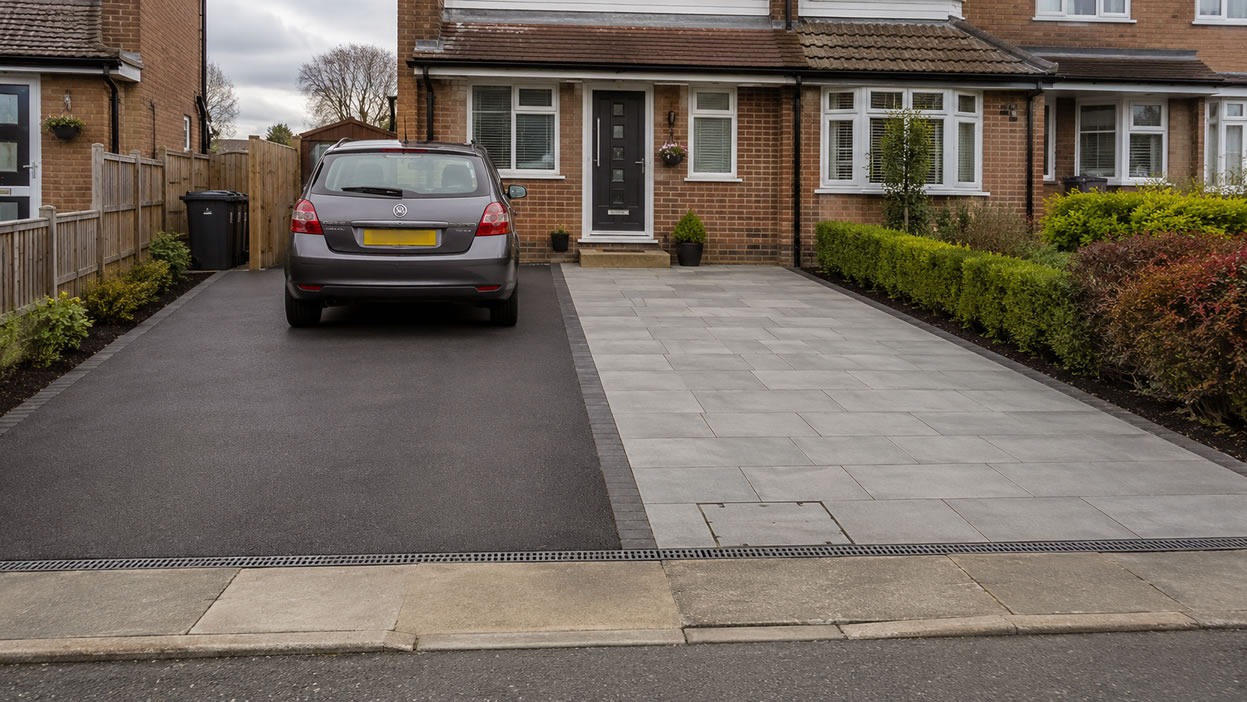
One popular approach is:
Asphalt centre + decorative border
Possible borders include:
- Block paving
- Granite setts
- Clay-style pavers
This adds definition without paving the whole driveway.
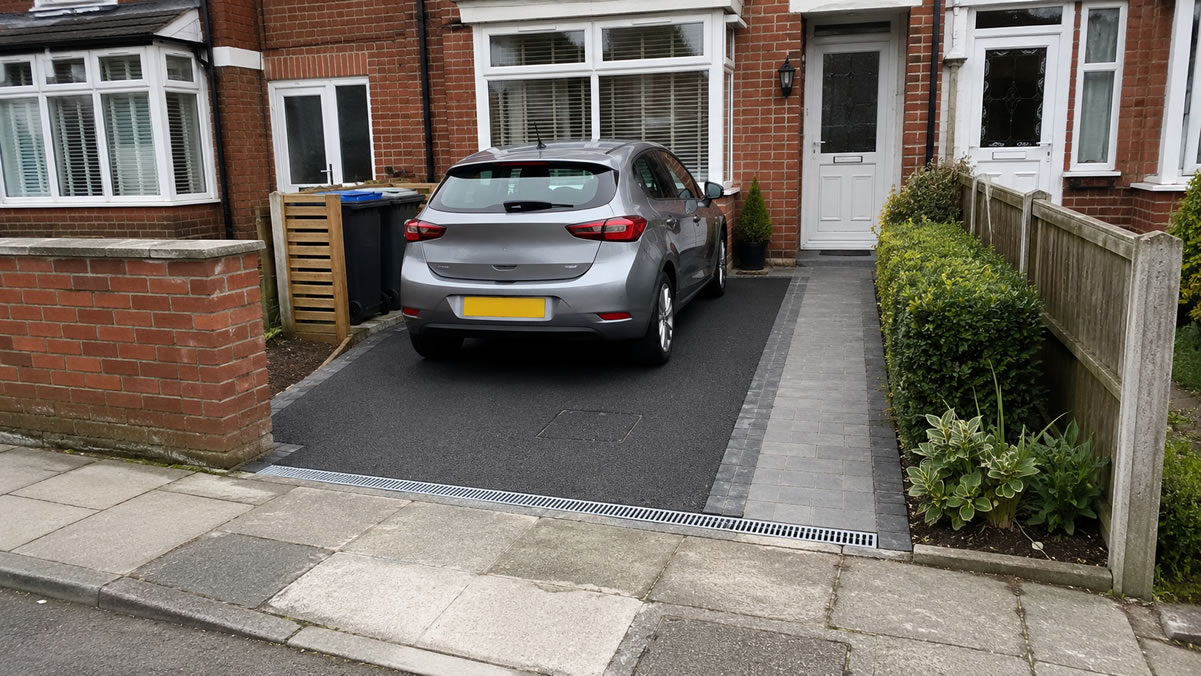
Asphalt With Paved Entrance
Another cost-saving design is to use:
- Asphalt for most of driveway
- Decorative paving at entrance
This concentrates more expensive material where it is most visible.
Asphalt With a Paved Path
A small front garden might use:
- Asphalt parking area
- Porcelain or sandstone path
This can provide a premium pedestrian route while keeping the main driveway affordable.
Which Looks Better on a Traditional House?
Often:
- Natural stone
- Tumbled blocks
- Traditional concrete paving
However, asphalt can still work well with:
- Brick edging
- Granite setts
- Planted borders
Which Looks Better on a Modern House?
Popular options include:
- Grey porcelain
- Large-format concrete
- Resin
- Dark asphalt with charcoal border
Therefore, asphalt can work very well in contemporary designs.
Drainage Can Affect the Price
Standard dense asphalt and many traditional slab installations are impermeable.
Rainwater must therefore be considered.
Options include:
- Drainage channels
- Soakaway
- Flower border
- Lawn
- Permeable strip
Drainage work can add hundreds or even thousands of pounds depending on the site.
Porous Asphalt
Porous asphalt is available.
It allows water through the surface when installed as part of a correctly designed permeable driveway system.
The layers underneath also need to allow water storage and drainage.
Permeable Paving Slabs
Paving can also form part of a permeable system.
This may involve:
- Specialist paving
- Permeable joints
- Open-graded sub-base
These systems usually cost more than basic traditional installation.
Front Garden Planning Rules in England
Planning rules can affect the final driveway design.
Current Planning Portal guidance says that planning permission is not normally required for a new or replacement front driveway if the surfacing is permeable, such as porous asphalt, or if rainwater is directed to a lawn or border where it can drain naturally.
If more than 5m² is covered with traditional impermeable surfacing and the water is not directed to a permeable area, planning permission is normally required.
Different rules can apply to flats, maisonettes and properties with restricted permitted development rights.
Does Drainage Make Asphalt More Expensive Than Slabs?
Not automatically.
Both surfaces may need drainage.
The important question is whether the complete system is:
- Permeable
- Impermeable
rather than whether it looks like asphalt or paving.
Dropped Kerb Costs
If you are converting a front garden into parking, a vehicle crossover may be required.
The dropped kerb is normally separate from the private driveway quotation.
This can add a significant amount to the project regardless of which surface you choose.
Which Surface Is Better for Heavy Cars?
Both can work.
For SUVs and vans, the most important factor is the construction underneath.
Asphalt needs:
- Suitable sub-base
- Adequate binder course
Paving needs:
- Suitable sub-base
- Correct bedding
- Vehicle-rated slabs
Stationary Steering
Heavy vehicles twisting their front wheels while stationary put considerable stress on the surface.
On asphalt, this may cause:
- Scuffing
- Surface movement in hot weather
On paving, it can contribute to:
- Joint stress
- Slab movement
Good construction reduces the problem.
Which Is Better for Vans?
For regular van use, asphalt often offers very good value.
It is widely used because it:
- Handles traffic well
- Has few joints
- Is easy to repair
Vehicle-rated concrete or granite paving can also perform very well, but generally costs more.
Which Is Better on a Slope?
Asphalt is often particularly suitable.
Its textured continuous surface provides good grip and avoids individual slabs moving independently.
Slabs can work on slopes too, but:
- Bedding
- Edge restraint
- Slip resistance
become especially important.
Which Is Better Around Manhole Covers?
Both can work.
With asphalt:
- Cover is adjusted
- Asphalt finished around it
With paving:
- Slabs need cutting neatly around cover
Recessed paving covers can create a cleaner appearance but add cost.
Asphalt vs Slabs for Weed Growth
Asphalt usually wins.
There are virtually no paving joints across the main surface.
Weeds may still grow:
- Along edges
- Through cracks
but routine weed maintenance is generally limited.
Slabs have joints where dirt and seeds can collect.
Which Is Easier to Clean?
Both are fairly straightforward.
Asphalt usually needs:
- Sweeping
- Occasional gentle washing
Slabs may need additional attention to:
- Joints
- Algae
- Stains
Porcelain is particularly easy to clean.
Oil Stains
Both can stain.
Asphalt
Oil and fuel can damage the bitumen binder if left for long periods.
Porcelain
Usually highly stain-resistant.
Concrete
Can absorb oil.
Natural Stone
Stain resistance varies considerably.
For homeowners who regularly work on cars, porcelain may have a practical advantage despite the higher initial cost.
Frost Resistance
Proper driveway products should be suitable for UK winters.
However, natural stone and lower-quality paving should be checked for:
- Frost resistance
- Water absorption
Asphalt generally performs well through ordinary UK freeze-thaw conditions if drainage and construction are good.
Which Is Better for Wheelchairs and Pushchairs?
Both can work well.
Asphalt creates one of the smoothest surfaces.
Large paving slabs can also be comfortable, provided:
- Joints are narrow
- Slabs remain level
Highly textured stone can be less convenient.
Which Is Better for Children?
Asphalt is smooth for:
- Bikes
- Scooters
although falls on it can be abrasive.
Paving also works well but joints can make small wheels slightly bumpier.
Installation Time
Asphalt is generally faster.
After groundwork, the surface itself can often be completed quickly.
Paving a large driveway may take several additional days because every unit needs to be laid individually.
How Soon Can You Use Asphalt?
Follow the contractor’s instructions.
New asphalt normally needs some time to cool and settle before regular vehicle use.
Avoid:
- Heavy stationary loads
- Tight steering
immediately after installation.
How Soon Can You Use Slabs?
This depends on:
- Bedding
- Jointing
- Mortar curing
A contractor may ask you to keep vehicles off the surface for several days.
Asphalt vs Slabs Cost Scorecard
| Cost Factor | Cheaper Option |
| Surface material | Asphalt |
| Labour | Asphalt |
| Large driveway | Asphalt |
| Curved driveway | Asphalt |
| Small rectangular area | Closer comparison |
| Maintenance | Asphalt |
| Invisible local repairs | Slabs |
| Utility access repairs | Slabs |
| Premium appearance | Slabs, but costs more |
| Resurfacing | Asphalt |
When Asphalt Is the Better Choice
Choose asphalt if your priorities are:
- Keeping costs down
- Low maintenance
- Fast installation
- Large driveway
- Narrow driveway
- Curved driveway
- Regular vehicle use
It is particularly attractive where the driveway is mainly practical parking rather than a major decorative feature.
When Slabs Are Worth the Extra Money
Choose paving slabs where:
- Kerb appeal is important
- You want a premium appearance
- You want more colours
- You prefer defined paving
- Individual repairs matter
- Budget allows
Best Compromise: Asphalt With Slab Edging
For many UK homes, this offers an excellent balance.
For example:
- Asphalt parking surface
- Granite or block edging
- Paved entrance
- Matching path
You retain most of asphalt’s cost advantage while improving the appearance.
Example 30m² Small Driveway
Possible broad budgets:
| Surface | Approximate Cost |
| Asphalt | £2,000–£3,000 |
| Concrete paving | £2,700–£4,200 |
| Better decorative paving | £3,000–£4,800 |
| Porcelain | £3,900–£6,600+ |
On a small job, actual quotations may vary considerably.
Example 50m² Driveway
| Surface | Approximate Cost |
| Asphalt | £3,500–£5,000 |
| Concrete paving | £4,500–£7,000 |
| Decorative paving | £5,000–£8,000 |
| Porcelain | £6,500–£11,000+ |
Recent UK market data puts a typical 50m² tarmac driveway around £4,500 and mainstream block paving around £5,000–£5,500, which illustrates how the gap can be modest for basic products but grows with premium paving.
Example 100m² Driveway
| Surface | Approximate Cost |
| Asphalt | £7,000–£10,000 |
| Concrete paving | £8,000–£12,000 |
| Decorative paving | £10,000–£16,000 |
| Porcelain | £13,000–£22,000+ |
This is where asphalt’s economy becomes particularly noticeable.
What Can Make Asphalt Expensive?
Costs rise where:
- Site access is poor
- Ground is soft
- Concrete needs removing
- Drainage is complicated
- Large retaining walls are needed
- Kerbs need major adjustment
- Small quantities of asphalt are required
What Makes Paving Expensive?
Costs rise with:
- Premium slabs
- Large-format units
- Complex cutting
- Curves
- Steps
- Multiple colours
- Natural stone
- Difficult access
- Intricate patterns
Do Not Compare Quotes Based Only on the Surface
One quote may include:
- Full excavation
- New sub-base
- Drainage
- Edging
while another simply proposes resurfacing an existing base.
The totals cannot be fairly compared.
What Should an Asphalt Quote Include?
| Item | Included? |
| Excavation | |
| Waste removal | |
| Sub-base | |
| Compaction | |
| Binder course | |
| Surface course | |
| Edge restraints | |
| Drainage | |
| Manhole adjustments | |
| VAT | |
| Guarantee |
What Should a Slab Driveway Quote Include?
| Item | Included? |
| Excavation | |
| Waste removal | |
| Sub-base | |
| Bedding system | |
| Paving product | |
| Slab thickness | |
| Manufacturer specification | |
| Jointing | |
| Edge restraints | |
| Drainage | |
| Cutting | |
| Manhole adjustments | |
| VAT | |
| Guarantee |
Questions to Ask Before Choosing
- What will each surface cost for the same driveway?
- Does each quote include full excavation?
- What sub-base depth is proposed?
- Are the slabs specifically vehicle-rated?
- What asphalt layers will be used?
- Where will rainwater go?
- How much maintenance will each surface require?
- What happens if underground utilities need accessing?
- How visible will repairs be?
- What guarantee is included?
Common Mistakes
Choosing Patio Slabs Because They Are Cheaper
They may not be designed for vehicles.
Comparing an Asphalt Resurface With a Full Paving Rebuild
These are completely different jobs.
Spending More on Slabs but Less on the Base
The foundation matters more than the decorative finish.
Ignoring Drainage
Both surfaces need proper surface-water management.
Assuming Asphalt Is Always Cheap on Small Jobs
Minimum plant and delivery charges can change the calculation.
Assuming Expensive Paving Lasts Forever
Installation quality remains critical.
Frequently Asked Questions
Is asphalt cheaper than paving slabs for a driveway?
Usually, yes. Asphalt generally costs less in materials and labour than vehicle-rated paving slabs.
How much cheaper is asphalt than paving?
The difference might be around £10–£50+ per square metre depending on the type of paving. Premium porcelain, granite and natural stone create a much larger price difference.
How much does an asphalt driveway cost per square metre?
A straightforward UK installation might broadly cost around £60–£100 per m², although site conditions can push prices outside this range.
How much do driveway slabs cost per square metre?
Basic vehicle-rated concrete paving may start around £80–£120 per m² installed, while premium porcelain or natural stone can exceed £150–£200 per m².
Is asphalt cheaper than concrete paving?
Usually, although the difference can be relatively small where basic concrete driveway paving is selected.
Is asphalt cheaper than porcelain paving?
Yes. Driveway-rated porcelain generally costs substantially more to buy and install.
Which lasts longer, asphalt or paving slabs?
Quality driveway paving can potentially outlast asphalt, but lifespan depends heavily on the base, installation quality, drainage and vehicle loading.
Which is cheaper to maintain?
Asphalt generally needs less routine maintenance because there are few joints and little opportunity for weed growth.
Are paving slabs easier to repair?
Individual slabs can often be lifted and replaced, which can make local repairs neater than asphalt patching.
Is asphalt good for a small driveway?
Yes, although very small projects may have relatively high square-metre costs because of minimum equipment and asphalt-delivery charges.
Is asphalt better for a large driveway?
It is often one of the most cost-effective choices for larger areas because installation becomes increasingly economical as the area grows.
Can I combine asphalt and paving slabs?
Yes. An asphalt driveway with a paving border, decorative entrance or paved path can provide a good compromise between cost and appearance.
Is porous asphalt available?
Yes. Porous asphalt can form part of a permeable driveway system when the underlying construction is designed appropriately.
Do I need planning permission for an asphalt driveway?
For houses in England, porous surfacing or an arrangement where water drains to a permeable lawn or border generally avoids the need for planning permission solely for the driveway surface. Traditional impermeable front-garden surfacing over 5m² can require permission if suitable on-site drainage is not provided.
Which gives better value, asphalt or paving slabs?
For practical parking and low initial cost, asphalt usually provides better value. Paving may be worth paying more for if appearance, colour choice and easier individual repairs are important.