

Small driveways can be surprisingly difficult to design well.
There may only be enough room for one car, while the frontage still needs to accommodate a path, bins, drainage, planting and access to the front door. Because space is limited, complicated paving patterns or wide decorative borders can sometimes make the area feel even smaller.
That is where tarmac can work particularly well.
A properly installed tarmac driveway creates one continuous parking surface with very few joints. It is practical, relatively quick to lay and usually costs less than premium block paving, porcelain or natural stone.
For many terraced and semi-detached UK homes, it can be one of the simplest ways to turn a small front garden into useful off-street parking.
However, there are several things to get right. Ground preparation, edging and drainage matter just as much as the black surface you see when the job is finished.
This guide explains when tarmac suits a small driveway, how much it may cost, what construction to expect and how to make a compact tarmac driveway look more attractive.
Is Tarmac a Good Choice for a Small Driveway?
In many cases, yes.
Tarmac works particularly well where the main priorities are:
- Practical parking
- Efficient use of limited space
- Relatively low maintenance
- Straightforward installation
- Sensible cost
- A smooth, firm surface
It also works well on awkward shapes because the material can follow curves and angled boundaries without requiring lots of individually cut paving units.
Tarmac for Small Driveways at a Glance
| Feature | How Tarmac Performs |
|---|---|
| One-car driveway | Excellent |
| Narrow driveway | Excellent |
| Irregular shapes | Excellent |
| Initial cost | Low to medium |
| Installation speed | Fast |
| Maintenance | Low |
| Weed growth | Low |
| Decorative choice | Limited |
| Drainage | Needs planning |
| Heavy cars | Good with correct base |
| Repairs | Straightforward but visible |
| Lifespan | Commonly 15–25+ years |
Tarmac or Asphalt: What Is the Difference?
Most homeowners still use the word tarmac, but modern residential driveways are normally surfaced with asphalt or bitumen-bound materials rather than traditional tar-based tarmacadam.
In everyday conversation, though, the terms are often used interchangeably.
When you ask a contractor for a tarmac driveway, they will usually specify a modern asphalt system made from:
- Aggregate
- Fine stone
- Bitumen binder
The material is delivered hot, laid and then compacted.
Why Tarmac Works So Well on Compact Front Gardens
Small driveways need to make maximum use of the space available.
A typical frontage may have to fit:
- One car
- Front-door access
- Wheelie bins
- Drainage
- A small planted area
- Side gate access
Tarmac helps because the main parking surface can remain visually simple.
You do not lose large areas to complex borders or oversized slabs.
Good for One-Car Driveways
One-car driveways are where tarmac often makes the most sense.
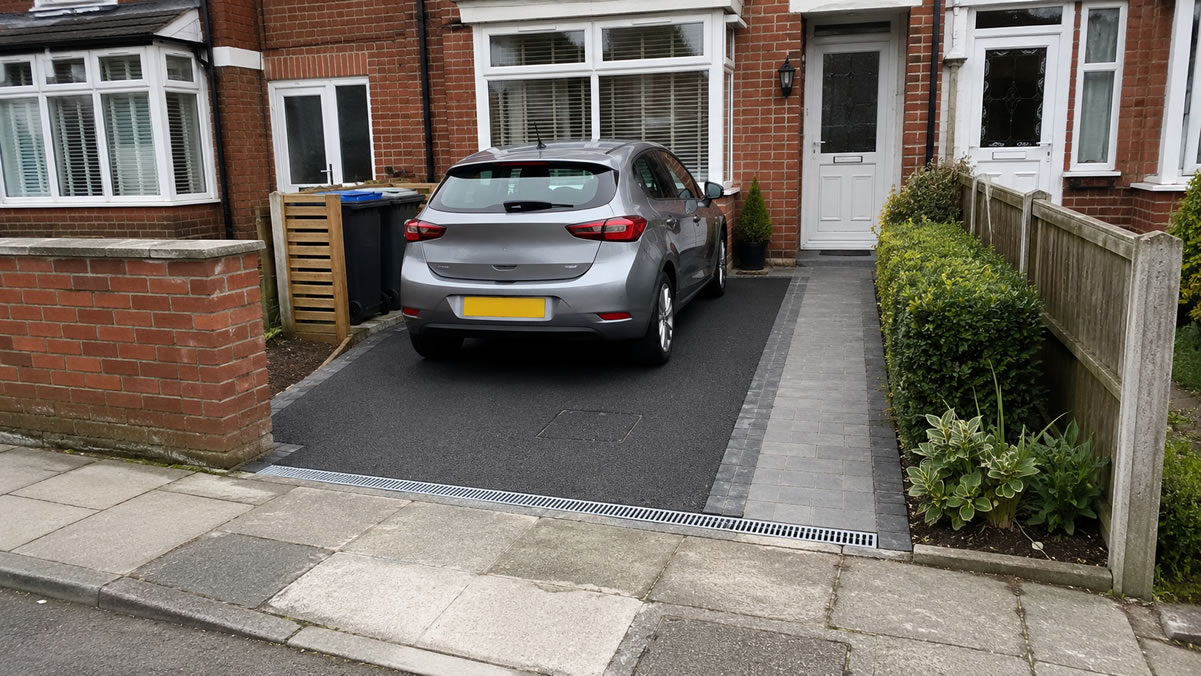
A basic design might include:
- Dark tarmac parking bay
- Narrow charcoal block border
- Small path
- Drainage channel
- One planting strip
This can produce a tidy frontage without making the design feel overdone.
Good for Narrow Driveways
Long, narrow drives beside the house can also suit tarmac.
The material can run neatly between:
- House wall
- Fence
- Boundary wall
- Garage
Paving the same area with large slabs might require many narrow cuts.
Good for Awkward Shapes
Small front gardens often contain:
- Bay windows
- Angled walls
- Existing steps
- Drainpipes
- Manholes
- Curved boundaries
Tarmac can be formed around these features relatively easily.
This can reduce both labour and material waste.
How Much Space Does One Car Need?
There is no single correct driveway size because modern vehicles vary significantly.
As a rough practical guide, many ordinary cars benefit from a space of around:
- 2.4–2.7 metres wide
- 4.8–5.5 metres long
Larger SUVs may require more.
You also need to allow for:
- Door opening
- Mirrors
- Walking alongside the vehicle
- House walls
- Gate posts
A driveway that technically fits the car but makes it impossible to open the doors is not particularly useful.
Measure Your Actual Car
Before committing to the layout, measure:
- Vehicle length
- Width
- Width including mirrors
- Door opening area
Then mark the proposed parking space on the ground.
You can use:
- String
- Chalk
- Timber battens
If possible, park the vehicle within those markings.
That gives a far more useful impression than relying on dimensions on paper.
Do Not Forget Pedestrian Access
A driveway should not make getting to the front door awkward.
Ideally, leave:
- A clear path
- Safe route past the car
- Access to bins
This is particularly important for:
- Pushchairs
- Wheelchairs
- Deliveries
Should a Small Driveway Keep Some Planting?
Where space allows, yes.
Even a narrow planted border can soften the appearance.
Good options include:
- Lavender
- Ornamental grasses
- Evergreen shrubs
- Small hedge
- Gravel bed
A fully paved or tarmacked frontage can sometimes feel quite stark.
Small Tarmac Driveway Design Ideas
Simple Black Tarmac
The cheapest and most straightforward option.
Best where practicality matters more than decoration.
Tarmac With Block Paving Border
Probably the most common upgrade.
A narrow edging in:
- Charcoal
- Grey
- Red
- Buff
can make the driveway look more finished.
Tarmac With Granite Setts
Granite provides a more premium border.
Because only a relatively small quantity is needed, the overall driveway can still remain affordable.
Tarmac With a Paved Path
Use tarmac for parking and slabs for the route to the front door.
This works particularly well on small semi-detached homes.
Tarmac With a Decorative Entrance
A short strip of blocks or setts at the pavement edge can add character without paving the entire driveway.
Which Border Colour Works Best?
Match the house rather than following trends.
Red-Brick House
Consider:
- Charcoal
- Brindle
- Dark red
Grey or Rendered House
Consider:
- Charcoal
- Mid-grey
- Light grey granite
Traditional Property
Red or weathered-looking blocks can work well.
Why Edging Is Important
Edging is not only decorative.
It helps restrain the asphalt.
Without proper support, exposed edges can gradually:
- Crumble
- Spread
- Crack
This is particularly likely where tyres repeatedly cross the edge.
Suitable Edging Materials
Options include:
- Concrete kerbs
- Block paving
- Granite setts
- Driveway bricks
- Concrete edging
The edging should be installed firmly before the final surface is laid.
What Goes Under the Tarmac?
A driveway is not just a thin black surface.
A typical construction may include:
- Excavated formation.
- Compacted sub-base.
- Asphalt binder course.
- Asphalt surface course.
- Edge restraints.
Drainage may also be incorporated.
Why the Sub-Base Is So Important
The sub-base supports vehicle loads.
If it is inadequate, the driveway may eventually develop:
- Ruts
- Depressions
- Cracks
- Puddles
- Edge failure
A thicker asphalt surface does not compensate for weak ground underneath.
Typical Tarmac Driveway Construction
| Layer | Purpose |
| Excavated formation | Removes unsuitable material |
| Granular sub-base | Distributes vehicle weight |
| Binder course | Structural asphalt layer |
| Surface course | Finished wearing layer |
| Edging | Prevents lateral movement |
Exact thicknesses depend on:
- Ground conditions
- Vehicle type
- Existing construction
How Deep Does a Small Driveway Need Excavating?
There is no standard excavation depth for every site.
For a complete new driveway, excavation of roughly 200mm or more may be required once space is allowed for:
- Sub-base
- Asphalt layers
- Finished levels
Soft ground may require deeper preparation.
Existing hardstanding can sometimes reduce the amount of excavation needed.
Can Existing Tarmac Simply Be Resurfaced?
Sometimes.
If the existing base remains structurally sound, resurfacing can be an economical option.
It may suit a driveway that is:
- Faded
- Lightly cracked
- Worn at surface level
When Resurfacing Is a Bad Idea
Do not simply cover over:
- Major settlement
- Large potholes
- Deep cracking
- Tree-root movement
- Poor drainage
These problems are likely to return.
Can Tarmac Be Laid Over Concrete?
Potentially.
A contractor needs to assess:
- Concrete condition
- Cracks
- Drainage
- Finished height
- Movement joints
Cracks in the concrete may eventually reflect through the asphalt above.
Tarmac Over Old Block Paving
This is generally less straightforward.
Loose or moving blocks are not a reliable base.
The contractor should inspect the existing construction rather than simply covering it.
Drainage Matters Even on a Tiny Driveway
A 20m² surface still collects a significant amount of rainwater.
Traditional dense asphalt is normally impermeable.
That means water needs to be directed somewhere.
Possible options include:
- Lawn
- Flower bed
- Gravel infiltration strip
- Suitable soakaway
- Linear drainage channel
Porous Asphalt
Porous asphalt systems are also available.
They allow rainwater through the surface.
However, the layers underneath need to form part of the drainage design.
Porous surfacing placed over an impermeable base will not function properly as a fully permeable system.
Linear Drainage Channels
These can be particularly useful:
- Outside garage doors
- Near front doors
- Across low points
The channel still needs a proper discharge point.
Keep Levels Away From the House
Do not raise the driveway unnecessarily against the property.
Particular attention should be paid around:
- Damp-proof course
- Air bricks
- Door thresholds
- Wall vents
The contractor should set finished levels before work starts.
Do You Need a Dropped Kerb?
If a vehicle needs to cross a public pavement, you normally need an approved vehicle crossover or dropped kerb.
The local council usually controls this work.
It is sensible to establish whether approval is possible before spending money converting the front garden into parking.
Why Dropped Kerb Approval Matters
Councils may consider:
- Width of frontage
- Parking-space depth
- Street trees
- Lamp posts
- Utility covers
- Visibility
If there is an obstacle directly outside the property, permission may be more difficult.
Tarmac for a Sloping Small Driveway
Tarmac often works very well on slopes.
Its textured continuous surface provides good grip.
However, water management becomes especially important.
Rainwater should not be directed:
- Into garage
- Towards house
- Onto pavement
Is Tarmac Slippery in Winter?
Normally it offers good grip.
However, it can become slippery if covered with:
- Ice
- Algae
- Moss
- Oil
Shaded areas should be kept reasonably clean.
Can Tarmac Handle SUVs?
Yes, if the base and asphalt construction are suitable.
A heavier SUV places more demand on the driveway than a small hatchback.
Tell the contractor what vehicles will regularly use the surface.
What About Vans?
A professionally constructed tarmac driveway can also support vans.
For regular heavy commercial use, the contractor may specify:
- Stronger base
- Heavier binder construction
Stationary Steering Can Mark New Tarmac
Turning the steering wheel while the vehicle is completely stationary creates a strong twisting load.
This can cause:
- Scuff marks
- Surface movement
especially when the asphalt is:
- New
- Warm
Try to move the car slightly while turning the steering.
Does Tarmac Melt in Hot Weather?
It should not literally melt under normal UK conditions.
However, very hot weather can soften the bitumen slightly.
Heavy concentrated loads may then leave marks.
Examples include:
- Motorbike stands
- Heavy trailer legs
- Skip legs
Use load-spreading pads where needed.
How Long Does a Tarmac Driveway Last?
A properly constructed domestic driveway can commonly last around:
15–25 years or more
before major resurfacing or replacement is required.
Its life depends heavily on:
- Groundwork
- Drainage
- Vehicle loading
- Trees
- Installation quality
- Maintenance
Does Tarmac Crack?
It can.
Common causes include:
- Weak base
- Ground movement
- Tree roots
- Water penetration
- Age
Small cracks can sometimes be repaired before they widen.
Does Tarmac Sink?
It can if the foundation settles.
Common signs include:
- Tyre depressions
- Puddles
- Low areas
Persistent sinking usually points to a problem below the surface.
Tree Roots
Trees close to a driveway can affect any hard surface.
Roots can:
- Lift asphalt
- Distort borders
- Cause cracking
Do not automatically cut major roots during excavation.
Some trees may also have legal protection.
Weed Growth
Tarmac generally performs well here because it has very few joints.
Weeds normally appear only:
- Along edges
- In cracks
- Around drains
This makes it relatively low maintenance compared with many paved driveways.
Moss and Algae
Older shaded tarmac can become green.
Regular sweeping helps reduce organic build-up.
Aggressive pressure washing is not always necessary and can loosen aggregate on worn asphalt.
Oil and Fuel
Oil can stain asphalt.
Petrol and other solvents can also soften the binder.
Deal with spills quickly and avoid harsh cleaning chemicals.
Repairing Tarmac
Typical repairs include:
- Crack filling
- Patching
- Edge reconstruction
- Pothole repairs
These are normally straightforward.
The main disadvantage is visual matching.
Will Repairs Show?
Usually.
Fresh asphalt is much darker than an older weathered surface.
The difference reduces over time but may never disappear completely.
Tarmac vs Block Paving on a Small Driveway
| Feature | Tarmac | Block Paving |
| Initial cost | Usually lower | Usually higher |
| Installation speed | Faster | Slower |
| Weed maintenance | Low | Moderate |
| Colours | Limited | Wide |
| Patterns | Limited | Wide |
| Irregular shapes | Very good | Good |
| Local repairs | Visible patch | Blocks can be replaced |
| Maintenance | Low | Moderate |
Tarmac vs Resin
| Feature | Tarmac | Resin |
| Cost | Lower | Higher |
| Appearance | Simple | Decorative |
| Colours | Limited | Wide |
| Maintenance | Low | Low |
| Permeable option | Yes | Yes |
| Repair matching | Difficult | Difficult |
Resin is often chosen where the homeowner wants a more decorative finish.
Tarmac vs Gravel
Gravel is usually cheaper initially.
However, gravel can:
- Move
- Rut
- Scatter onto pavement
- Need topping up
Tarmac provides a firmer surface and easier wheeled access.
Tarmac vs Driveway Slabs
Tarmac generally wins on:
- Cost
- Speed
- Awkward shapes
Driveway slabs generally win on:
- Premium appearance
- Colour choice
- Individual replacement
Typical Small Tarmac Driveway Costs
Broad UK budgeting figures could look like:
| Driveway Size | Typical Budget |
| 15m² | £1,500–£2,500 |
| 20m² | £1,700–£3,000 |
| 30m² | £2,200–£3,800 |
| 40m² | £2,800–£4,500 |
These are indicative ranges only.
Ground preparation can move the price considerably.
Typical Price Per Square Metre
For a straightforward full installation, a broad range might be:
£60–£100+ per m²
Small jobs often sit towards the upper end because of fixed costs.
Why Small Jobs Cost More Per Square Metre
Contractors still need:
- Roller
- Compactor
- Crew
- Transport
- Asphalt delivery
whether the job is 20m² or 100m².
On a larger project, those fixed costs are spread across more area.
Additional Costs
Excavation
Can increase the price significantly.
Concrete Removal
Heavy existing slabs may be expensive to break and dispose of.
Drainage
Channels or soakaways add cost.
Decorative Edging
Block or granite borders increase labour and material costs.
Manholes
Covers may need to be raised.
Dropped Kerb
Normally priced separately.
Example Small Driveway Budget
Imagine a 25m² front garden.
Possible breakdown:
| Item | Indicative Cost |
| Excavation and waste | £500–£900 |
| Sub-base | £400–£700 |
| Asphalt layers | £900–£1,400 |
| Edging | £300–£600 |
| Drainage | £250–£600 |
Possible total:
Around £2,350–£4,200
Actual quotes may be lower or higher depending on site conditions.
Is Decorative Edging Worth the Cost?
Often, yes.
On a small driveway, even a single block border can make a big difference.
It adds:
- Definition
- Structural restraint
- Contrast
without consuming much of the budget.
Can Tarmac Look Too Industrial?
It can if the entire frontage is simply black surface.
You can soften it with:
- Brick edging
- Planting
- Attractive front path
- Timber bin screen
- Gravel strip
A little landscaping usually makes a substantial difference.
Small Tarmac Driveway With EV Charger
If you expect to install an EV charger, plan it before surfacing.
Consider:
- Charger wall location
- Cable route
- Which side of car contains charge port
- Spare ducting
Installing ducts now is far easier than cutting the finished tarmac later.
Wheelie-Bin Storage
Plan the bins early.
A small recess beside the driveway can prevent them blocking:
- Car doors
- Path
- Front entrance
A timber screen can make the frontage look much tidier.
Lighting
For small driveways, wall-mounted lighting often works best.
It uses no ground space.
Possible options include:
- PIR wall light
- Porch light
- Garage downlight
Avoid bollards where car doors may hit them.
Small Tarmac Driveway Ideas by Property Type
Terraced House
Keep it minimal:
- Tarmac parking bay
- Narrow path
- Simple edging
Semi-Detached House
Consider:
- Tarmac
- Block border
- Planting strip
- Bin enclosure
Modern New Build
Try:
- Dark asphalt
- Charcoal edging
- Anthracite lighting
Traditional Red-Brick Home
Use:
- Tarmac
- Red or brindle block edging
- Low hedge
Common Installation Mistakes
Weak Sub-Base
This is one of the biggest causes of early failure.
No Edge Restraint
Edges begin to crumble.
Poor Drainage
Creates puddles and water problems.
Incorrect Levels
Can direct rainwater towards the house.
Tarmacking Over a Failed Base
Cracks and settlement return.
Driveway Too Small
The car physically fits but doors cannot open.
Too Much Decoration
A compact frontage can quickly look cluttered.
What Should a Tarmac Driveway Quote Include?
| Quote Item | Why It Matters |
| Total area | Confirms measurement |
| Excavation depth | Indicates groundwork |
| Waste removal | Can be significant |
| Sub-base type | Critical for durability |
| Sub-base depth | Helps compare quotes |
| Binder course | Structural asphalt |
| Binder thickness | Important specification |
| Surface course | Finished layer |
| Surface thickness | Helps compare quality |
| Edging | Supports perimeter |
| Drainage | Controls rainwater |
| Manhole work | Often overlooked |
| VAT | Confirms final price |
| Guarantee | Shows workmanship cover |
Questions to Ask a Tarmac Contractor
- How deep will you excavate?
- What sub-base will you use?
- What compacted depth will it be?
- Is a binder course included?
- What surface course will you use?
- How will the edges be supported?
- Where will rainwater go?
- Is porous asphalt an option?
- Are drains included?
- Will manholes be adjusted?
- Is waste removal included?
- Is VAT included?
- How long before I can park on it?
- What guarantee do you provide?
Small Tarmac Driveway Checklist
| Check | Completed? |
| Vehicle measured | |
| Driveway width checked | |
| Door clearance checked | |
| Pedestrian access planned | |
| Bin position planned | |
| Dropped kerb checked | |
| Drainage planned | |
| Excavation specified | |
| Sub-base specified | |
| Asphalt layers specified | |
| Edging chosen | |
| Manholes checked | |
| EV duct considered | |
| Lighting planned | |
| Quotes compared |
Is Tarmac Worth Using for a Small Driveway?
For many UK homes, yes.
It is particularly suitable where you want:
- A practical parking area
- Low maintenance
- Fast installation
- Good use of limited space
- Lower cost than many decorative paving systems
Its biggest weakness is appearance.
However, that can often be solved with relatively simple additions such as:
- Block edging
- Granite setts
- Planting
- A paved footpath
The most important part remains underneath.
A modest-looking tarmac driveway built on a strong sub-base with good drainage will normally be a better investment than an expensive decorative surface laid over inadequate groundwork.
Frequently Asked Questions
Is tarmac suitable for a small driveway?
Yes. Tarmac is particularly suitable for compact driveways because it creates a continuous surface and uses limited space efficiently.
How much does a small tarmac driveway cost?
A small domestic tarmac driveway may broadly cost around £1,500–£4,000 depending on size, excavation, drainage and edging.
Is tarmac cheaper than block paving?
Usually. Tarmac generally costs less in both materials and labour than block paving.
Does tarmac need a sub-base?
Yes. A properly compacted sub-base is essential for supporting vehicle loads and reducing settlement.
Can tarmac be laid over an existing driveway?
Sometimes. Resurfacing may be possible if the existing base is structurally sound and drainage is suitable.
Can tarmac be laid over concrete?
Potentially, although cracks, movement and finished levels need to be assessed first.
How long does tarmac last?
A properly constructed domestic driveway can commonly last around 15–25 years or more.
Is tarmac suitable for SUVs?
Yes, provided the construction beneath the surface is suitable for the expected vehicle loading.
Is tarmac suitable for vans?
Yes. Regular heavier vehicles may justify a stronger base and asphalt specification.
Does tarmac need edging?
Yes. Proper edge restraint helps prevent the perimeter from crumbling and spreading.
Does a tarmac driveway need drainage?
Yes. Conventional asphalt is generally impermeable, so rainwater must be directed towards an appropriate drainage area or system.
Is porous tarmac available?
Yes. Porous asphalt can form part of a permeable driveway system where the underlying layers are also designed for drainage.
Can weeds grow through tarmac?
Weed growth is usually limited, although weeds can appear along edges, in cracks and around drains.
Can a tarmac driveway be repaired?
Yes. Cracks, potholes and damaged edges can usually be repaired, although new patches may remain visible.
Is tarmac a good option for a narrow driveway?
Yes. It is particularly well suited to narrow or irregular areas because it does not require lots of individually cut paving units.