

If you’re thinking about gutter protection in the UK, you’ll keep seeing two “mainstream” options:
- Hedgehog gutter guards (the brush inserts that sit inside the gutter)
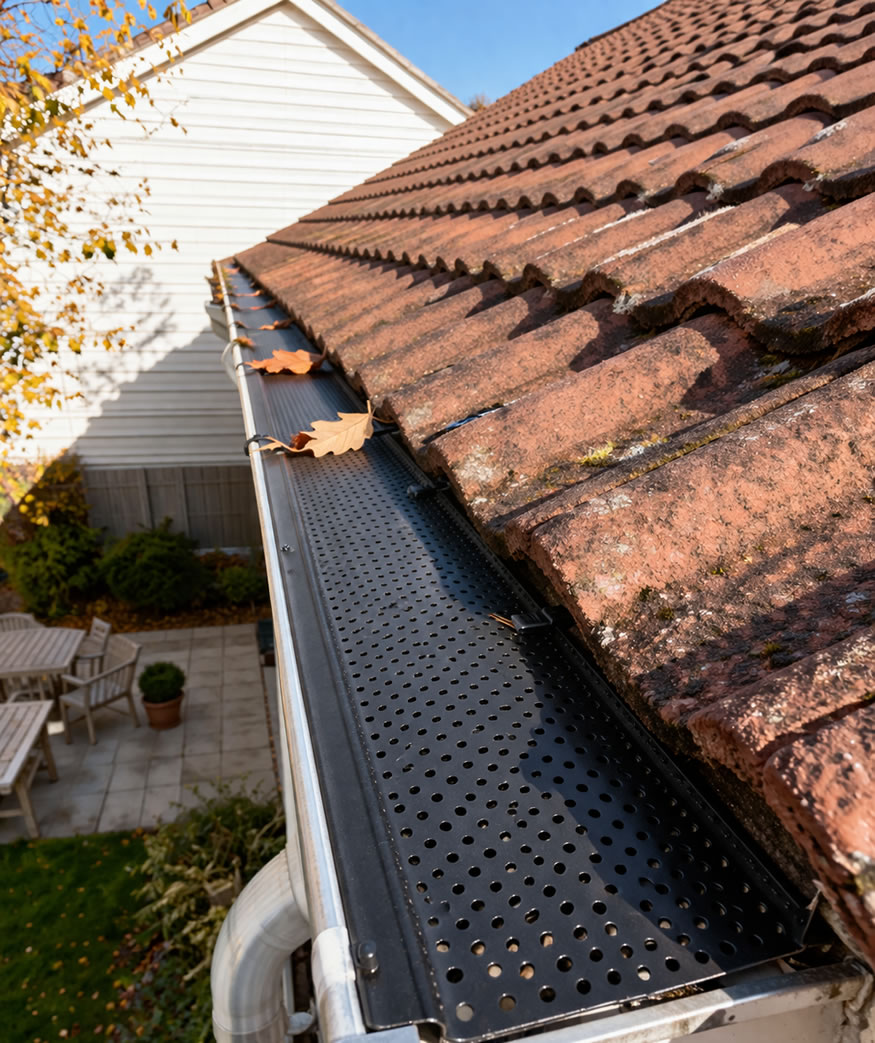
- Mesh gutter guards (clip-on/roll mesh that sits over the gutter opening)
Both can work. Both can also disappoint if you buy the wrong type for your guttering, roof, and nearby trees.
This advice guide compares them properly — including the bits people only find out after the first autumn.
The quick verdict
- Best all-rounder for most UK homes: mesh (when it’s a decent fit and not too coarse)
- Best for heavy leaf fall where you want easy “pull out and rinse” maintenance: hedgehog/brush
- Best for pine needles: generally fine micro-mesh, not standard mesh and not brush (unless you’re happy to rinse it more often)
The “best” gutter leaf guard depends on what’s falling into your gutters and how often you’re willing to maintain it.
What UK gutters actually block with (it’s not just leaves)
Most blockages come from a mix of:
- leaves and twigs (autumn)
- roof moss fragments and silt
- seed pods (e.g., sycamore “helicopters”)
- pine needles in some areas
- grit from older roofs or nearby trees
So a guard that’s perfect for big leaves can still struggle with fine debris.
How each guard works (in plain English)
Hedgehog / brush guards
- Sit inside the gutter.
- Leaves collect on top and within the bristles.
- Water runs through the bristles into the gutter.
- You remove sections and rinse them when needed.
Mesh guards
- Sit over the gutter opening.
- Leaves and moss collect on top of the mesh.
- Water passes through (ideally quickly).
- Debris is meant to blow away or be brushed off.
Head-to-head comparison (UK reality)
1) Performance in heavy leaf fall (typical UK autumn)
Hedgehog:
✅ Very good at stopping big leaves from packing the gutter solid.
⚠️ Leaves can sit in the bristles and compost down if you never remove them.
Mesh:
✅ Good at stopping big leaves entering the gutter.
⚠️ If debris sits on top, it can form a “mat” and slow drainage in prolonged wet spells.
Winner: tie — both work well, but hedgehog wins if you want easy manual maintenance.
2) Moss from roof tiles (common UK issue)
Hedgehog:
⚠️ Moss granules can lodge in bristles and become sludge.
✅ Still easier to clean by pulling sections out.
Mesh:
✅ Stops clumps entering.
⚠️ Fine moss can still wash through some meshes and settle as silt inside the gutter.
Winner: depends — if you have heavy moss shedding, neither is magic; hedgehog is often easier to “reset” by rinsing.
3) Pine needles (the hardest test)
Hedgehog:
⚠️ Needles can work down into bristles and hold wet debris. You’ll likely be rinsing more often.
Standard mesh:
⚠️ Many meshes are too coarse and needles slip through.
Fine micro-mesh:
✅ Generally the best at keeping needles out, but may need occasional top brushing.
Winner: fine micro-mesh (not standard mesh, and brush only if you accept regular rinsing).
4) Overflow risk in UK downpours
This is where poor choices show up fast.
Hedgehog:
⚠️ If the brush gets packed with wet debris, water can back up and overflow.
✅ If maintained, it generally lets water through well.
Mesh:
⚠️ If the mesh is too fine, sags, or clogs with organic film, water can overshoot the gutter edge.
✅ Good-quality mesh with correct fixing usually handles heavy rain well.
Winner: tie — both can overflow if neglected. The safer choice is whichever you’ll actually maintain.
5) Maintenance reality (be honest)
If you want “fit once, never think again”, neither option is perfect.
Hedgehog maintenance:
- Usually: pull out sections, shake/rinse, put back.
- Frequency: often 1–2 times a year in normal areas, more under heavy trees/pines.
Mesh maintenance:
- Usually: brush off the top surface, check outlets, quick visual inspection.
- Frequency: typically 1–2 times a year, but depends on tree cover.
Winner: hedgehog for easiest hands-on maintenance; mesh for lowest “mess factor”.
6) DIY installation difficulty
Hedgehog:
✅ Very easy — cut to length, drop in.
⚠️ Must match gutter width/shape properly or it can float/shift.
Mesh:
✅ Often easy, but…
⚠️ fit matters (clips, overlaps, corners). Poorly fitted mesh can lift in wind or leave gaps that funnel debris in.
Winner: hedgehog for simplest DIY.
7) Looks and kerb appeal
Hedgehog: invisible from ground level.
Mesh: sometimes visible at the edge depending on type/colour.
Winner: hedgehog if you care about aesthetics.
Which is better for most UK homes?
For many typical UK houses (mixed leaf fall, no pine forest overhead):
Choose mesh if:
- your main problem is leaves and moss clumps
- you prefer brushing debris off the top rather than pulling anything out
- you want to keep the gutter interior clearer
Choose hedgehog/brush if:
- you get heavy leaf fall and want an easy rinse-and-reset solution
- you have awkward access but can still safely remove sections periodically
- you’d rather deal with “stuff in the brush” than “stuff in the gutter”
Choose micro-mesh if:
- pine needles are a big issue
- you want maximum debris exclusion
- you’re prepared for light periodic top cleaning
The one thing that matters more than guard type
If your gutters overflow because:
- the gutter fall is wrong
- the downpipe is partially blocked
- the outlet is undersized
…no guard will fix that. You need the drainage corrected first.
Buyer checklist (so you don’t waste money)
Before you buy:
- What’s blocking your gutters: big leaves, moss, needles, silt?
- Do you have pine trees? (If yes, lean micro-mesh.)
- Are your gutters already sagging or holding water? Fix that first.
- How will you maintain it: brush top, or pull out and rinse?
- Do you need corners, valleys, conservatory sections considered?
FAQs
Is hedgehog or mesh better in heavy UK leaf fall?
Both can work. Hedgehog guards are often easier to maintain because you can lift and rinse sections. Mesh is good if you’re happy brushing debris off the top surface.
Which is better for pine needles?
Fine micro-mesh is usually best. Standard mesh can be too coarse and hedgehog brushes can trap needles inside the bristles, needing more frequent rinsing.
Do either make gutters maintenance-free?
No. Both reduce blockages and cleaning frequency, but you should still check gutters periodically and keep outlets/downpipes clear.