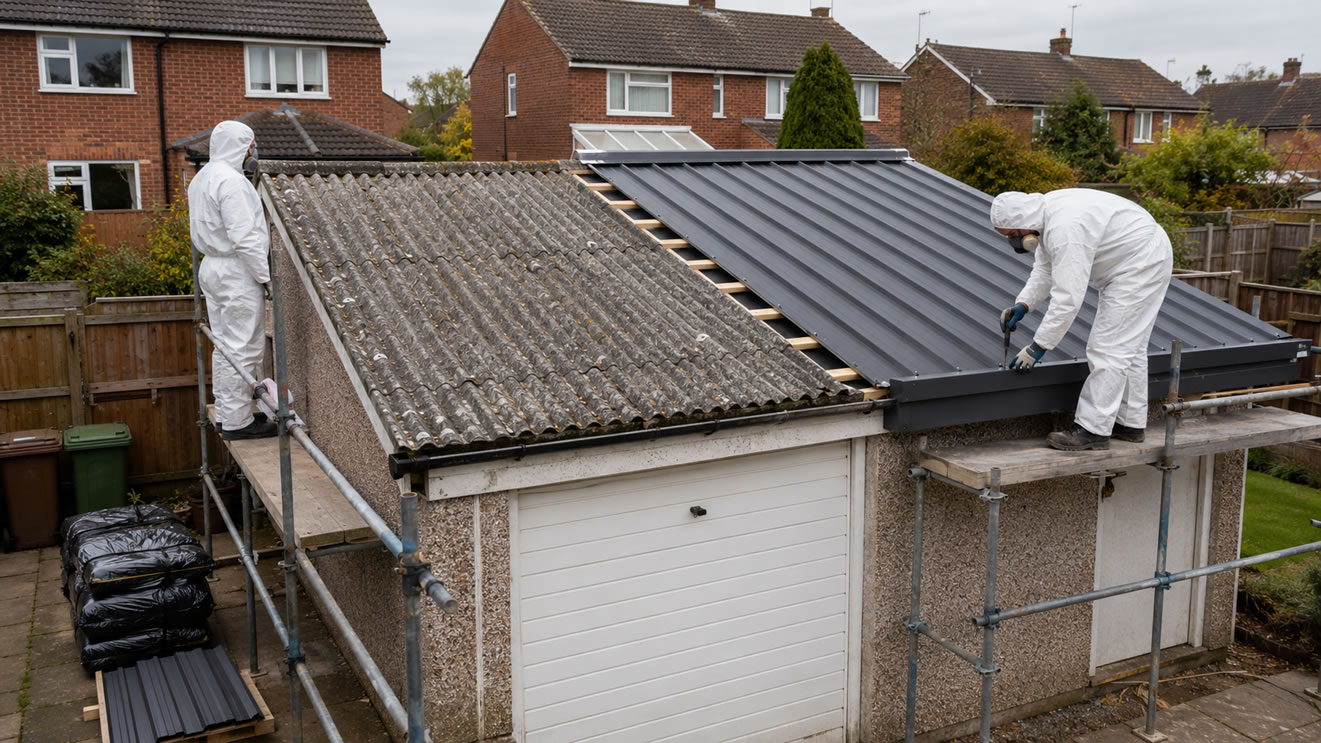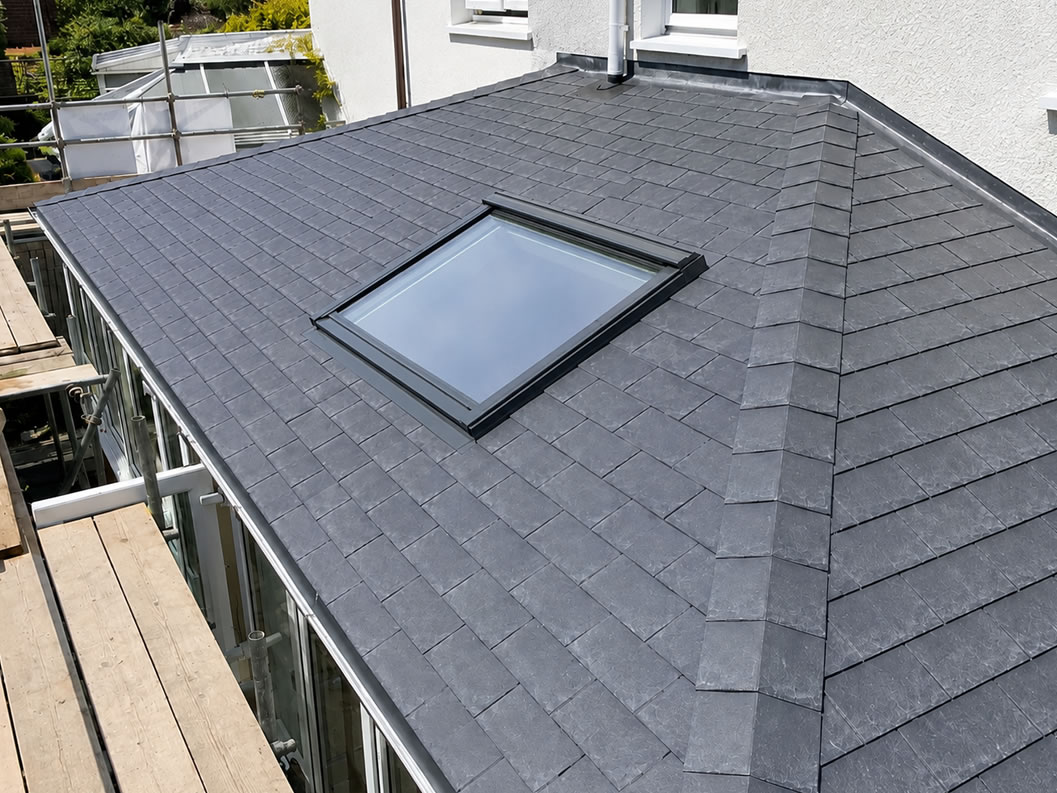


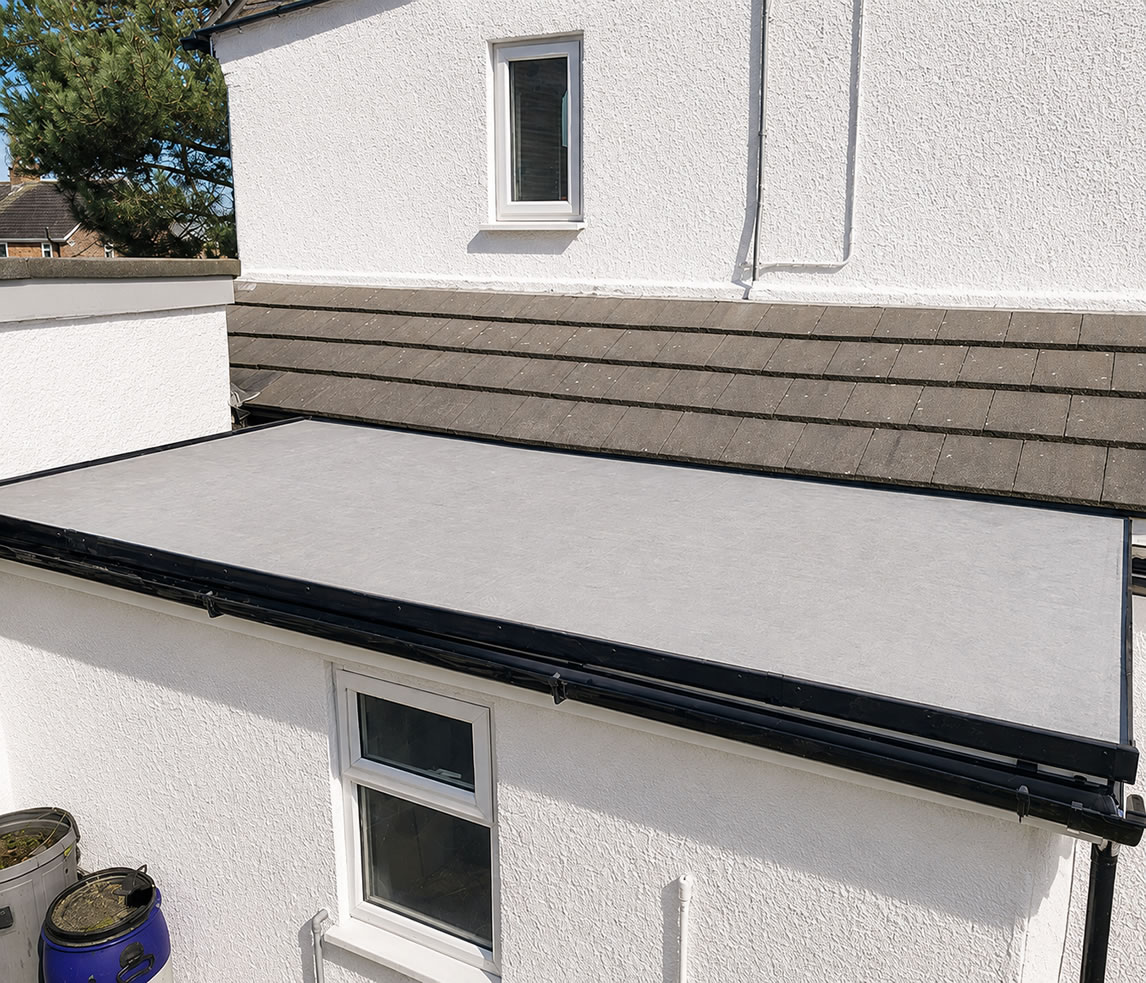
Flat roofs are common on extensions, garages, porches, dormers, workshops and commercial buildings throughout the UK. Although they are described as flat, a correctly built roof should have a slight slope that carries rainwater towards an outlet or gutter.
A well-installed flat roof can last for decades. However, its lifespan depends heavily on the covering, the quality of the roof deck, the drainage design and how well the installer completes vulnerable areas such as edges, outlets and rooflight upstands.
Some roofs fail much earlier than expected because of poor workmanship or standing water. Others continue performing beyond their typical lifespan because they were installed correctly and maintained regularly.
Age alone does not tell you whether a flat roof needs replacing. A 12-year-old roof with widespread bubbling and damp decking may need complete renewal, while a sound 25-year-old roof may only require minor maintenance.
This guide explains how long the main types of flat roofing last, what causes early failure and how to decide between repair and full flat roof replacement.
What Is the Typical Lifespan of a Flat Roof?
Depending on the material, a flat roof may last anywhere from around 10 years to more than 40 years.
The table below provides a broad guide for common UK flat roofing systems.
| Flat roof covering | Typical lifespan |
|---|---|
| Traditional pour-and-roll felt | 10–20 years |
| Modern torch-on felt | 15–30 years |
| EPDM rubber | 25–40 years or more |
| GRP fibreglass | 20–30 years |
| Single-ply membrane | 25–40 years |
| Liquid-applied roofing | 15–30 years |
| Mastic asphalt | 30–50 years |
| Green roof waterproofing system | 30–50 years with correct maintenance |
These are estimated service lives rather than fixed expiry dates.
A low-quality roof can fail within a few years. In contrast, a properly specified system may continue performing beyond the upper end of its expected lifespan.
How Long Does a Felt Flat Roof Last?
Felt remains one of the most familiar flat roofing materials in the UK. Roofers commonly use it on garages, sheds, porches, dormers and domestic extensions.
However, there is an important difference between basic shed felt and a professionally installed multi-layer roofing system.
Traditional Felt Roofs
Older felt roofs often used a pour-and-roll installation method. The roofer applied hot bitumen between layers of roofing felt.
These roofs commonly last around 10 to 20 years. Some last longer, although cracking, blistering and split joints become more likely as the material ages.
Modern Torch-On Felt
Modern high-performance felt normally includes several bonded layers. The installer uses heat to seal the membrane and form a continuous waterproof covering.
A good-quality torch-on felt roof may last between 15 and 30 years.
Its lifespan depends on:
- The number of layers
- Membrane quality
- Roof preparation
- Deck condition
- Installation around edges
- Drainage
- Exposure to sunlight
- Frequency of foot traffic
Modern felt is generally more durable than the basic mineral felt used on many garden sheds.
How Long Does an EPDM Rubber Roof Last?
EPDM is a synthetic rubber membrane used on extensions, garages, garden rooms and commercial roofs.
Manufacturers often supply the membrane in large sheets. Therefore, a straightforward roof may have very few field joints.
An EPDM roof can commonly last 25 to 40 years or more when installed correctly.
The rubber itself is highly resistant to weathering. However, failures may still occur around:
- Roof edges
- Outlets
- Wall junctions
- Rooflights
- Pipe penetrations
- Adhesive bonds
- Poorly formed corners
The membrane may remain in good condition while a badly installed trim or outlet begins leaking.
For this reason, installation quality is just as important as the expected lifespan of the material.
How Long Does a GRP Fibreglass Roof Last?
GRP stands for glass reinforced plastic. It is often called fibreglass roofing.
The installer applies resin and fibreglass matting over a suitable timber deck. Once cured, the system forms a hard, seamless surface.
A properly installed GRP roof may last around 20 to 30 years. Some systems last longer when they receive suitable maintenance and avoid excessive movement.
GRP can work well on smaller roofs with a simple shape. However, poor installation can lead to cracking, especially when:
- The deck moves
- Expansion joints are missing
- The roof is installed in unsuitable weather
- The resin mix is incorrect
- The roof covers a large or complicated area
- The substrate contains moisture
- The roof lacks the correct perimeter trims
Localised cracking may sometimes be repaired. Widespread cracks can indicate a deeper problem with the roof deck or installation.
How Long Does a Single-Ply Roof Last?
Single-ply roofing uses flexible sheets made from materials such as PVC or TPO.
These systems are common on commercial buildings, apartment blocks and larger domestic extensions. Installers join the membrane using heat-welded seams.
A well-designed single-ply roof can often last between 25 and 40 years.
Because the seams require specialist installation, homeowners should choose a contractor who has experience with the particular membrane system.
Common weak points include poorly completed welds, punctures and badly formed details around penetrations.
How Long Does a Liquid Flat Roof Last?
Liquid roofing systems create a continuous waterproof layer across the existing roof or a prepared new deck.
They can be useful on roofs with awkward shapes, numerous pipes or complicated junctions.
Depending on the system and specification, liquid roofing may last between 15 and 30 years.
However, not every liquid coating provides the same result. A thin repair product from a tin should not be confused with a professionally installed reinforced waterproofing system.
The condition of the surface beneath the liquid membrane is also important. Applying a coating over wet, rotten or unstable decking will not provide a lasting repair.
How Long Does a Mastic Asphalt Roof Last?
Mastic asphalt is a durable flat roofing material with a long history of use in the UK.
A properly installed asphalt roof may last between 30 and 50 years. It can provide a tough and dependable surface, although repairs and installation normally require a specialist contractor.
Asphalt can become brittle with age. Cracks may develop when the structure moves or when the roof experiences repeated temperature changes.
Nevertheless, many older asphalt roofs remain serviceable after localised repairs.
Flat Roof Lifespan Comparison
| Material | Typical life | Main strength | Common weakness |
| Basic felt | 10–15 years | Low initial cost | Shorter lifespan |
| Torch-on felt | 15–30 years | Familiar and repairable | Joints and blisters |
| EPDM rubber | 25–40+ years | Flexible with few seams | Vulnerable detailing |
| GRP fibreglass | 20–30 years | Hard and seamless | Can crack with movement |
| Single-ply | 25–40 years | Suitable for larger roofs | Specialist installation |
| Liquid membrane | 15–30 years | Good for complex details | Depends on preparation |
| Mastic asphalt | 30–50 years | Strong and durable | Can crack as it ages |
The best material depends on the roof rather than lifespan alone.
For example, GRP may suit a small rectangular extension, while a reinforced liquid system may work better on a complex roof with several penetrations.
Why Do Some Flat Roofs Fail Early?
A roof may fail years before its expected lifespan when the design or installation contains weaknesses.
Poor Drainage
Standing water is one of the most common flat roof problems.
A correctly designed roof should direct water towards outlets or gutters. Small areas of temporary water may not always cause immediate failure, but large or persistent pools place extra pressure on the covering.
Ponding water can:
- Add weight to the roof
- Encourage dirt and plant growth
- Find weak joints
- Increase freeze-and-thaw damage
- Speed up surface deterioration
- Reveal low areas in the roof deck
Repeated ponding often suggests inadequate falls, blocked drainage or movement in the deck.
Poor Installation
Even a premium membrane can fail when it is badly fitted.
Common workmanship problems include:
- Inadequate bonding
- Open seams
- Poor edge details
- Incorrect flashing
- Badly fitted outlets
- Wrinkles in membranes
- Insufficient upstand height
- Incorrect use of adhesives
- Trapped moisture
- Missing reinforcement
Some installation faults cause leaks almost immediately. Others remain hidden until the roof has experienced several winters.
A Damaged or Weak Roof Deck
The waterproof covering relies on the deck beneath it.
Old timber decking may suffer from:
- Rot
- Delamination
- Sagging
- Moisture damage
- Inadequate thickness
- Loose fixings
- Movement between boards
Installing a new membrane over a weak deck may only hide the problem temporarily.
Blocked Outlets and Gutters
Leaves, moss and debris can prevent rainwater from leaving the roof.
The water then collects around outlets, joints and wall connections. During heavy rain, it may rise above details that were not designed to remain submerged.
Regular cleaning is a simple way to reduce the risk of premature failure.
Too Much Foot Traffic
Most domestic flat roofs are not designed as balconies or regular walking surfaces.
Frequent foot traffic can puncture membranes, damage mineral finishes and place pressure on joints.
Anyone accessing the roof should use appropriate walkways or protection boards where required.
Unsuitable Repairs
Temporary repairs can cause additional problems when homeowners use products that are incompatible with the original roof.
For example, some coatings do not bond properly to damp, dirty or weathered surfaces.
A patch may hide a visible split while water continues travelling beneath the covering.
Movement and Temperature Changes
Flat roofs heat up in direct sunshine and cool down rapidly at night. Roofing materials expand and contract as the temperature changes.
The roof system must allow for this movement.
Rigid materials such as GRP can crack when the deck moves more than expected. Felt can split at joints, while trims and flashings may pull away from edges.
Poor Ventilation or Condensation
Not every flat roof leak comes from rain.
Warm, moisture-laden air from inside the building can reach cold parts of the roof and form condensation. Over time, this may wet the insulation and timber deck.
A poorly ventilated cold roof or incorrectly designed insulation system can develop hidden moisture damage even when the external covering looks sound.
What Factors Affect Flat Roof Lifespan?
Two roofs made from the same material can have very different lifespans.
| Factor | Effect on lifespan |
| Installation quality | One of the biggest influences |
| Roof falls | Good falls reduce standing water |
| Drainage maintenance | Clear outlets lower leak risk |
| Roof deck condition | A stable deck protects the covering |
| Sun exposure | UV exposure ages some materials |
| Nearby trees | Leaves and branches increase maintenance |
| Foot traffic | Raises the risk of punctures and wear |
| Number of joints | More joints can create more weak points |
| Roof complexity | Corners and penetrations need careful detailing |
| Insulation design | Poor design can cause condensation |
| Coastal exposure | Strong winds and salt may increase wear |
| Repairs and inspections | Early action can prevent wider damage |
Signs That a Flat Roof Is Nearing the End of Its Life
A roof does not need replacing simply because it has reached a certain age. However, several warning signs together may indicate that replacement is approaching.
Repeated Leaks
One isolated leak may come from a small defect. Repeated leaks in different areas often suggest wider deterioration.
If repairs only stop the leak temporarily, water may be travelling beneath the covering or entering through several weak points.
Widespread Cracking
Small surface marks do not always mean the roof has failed. However, widespread cracking can allow water through the waterproof layer.
Cracks often appear around:
- Joints
- Roof edges
- Wall junctions
- Outlets
- Previous repairs
- Areas where the deck moves
Multiple cracks across an ageing roof may make complete replacement more practical than continued patching.
Blisters and Bubbles
Blisters form when moisture or air becomes trapped beneath felt or another bonded membrane.
Small stable blisters may not leak immediately. However, they can split under foot pressure or during temperature changes.
Numerous or growing blisters often indicate poor adhesion or trapped moisture across a wider area.
Ponding Water
Water remaining on the roof long after rainfall may point to inadequate falls or a sagging deck.
The membrane may still be waterproof, but ongoing ponding increases the risk of later failure.
A roofer should investigate why the water is not draining.
Soft or Bouncy Areas
A flat roof should feel stable under controlled access.
Soft, spongy or bouncy sections can indicate rotten decking, wet insulation or loose boards.
This problem requires more than a surface patch. The contractor may need to open the roof and replace damaged materials.
Sagging
Visible dips can develop when the deck or supporting structure moves.
Sagging creates low points where water collects. It may also indicate timber deterioration or inadequate joist support.
Structural movement should be investigated promptly.
Loose Edges or Flashing
The perimeter and wall junctions often fail before the main roof surface.
Look for:
- Lifted trims
- Loose flashing
- Open seams
- Cracked sealant
- Gaps at wall connections
- Membrane pulling away from edges
Some of these problems can be repaired if the rest of the roof remains sound.
Moss, Weeds or Plant Growth
Plants need moisture and debris to grow.
Significant vegetation may show that water has been sitting on the roof for long periods. Roots can also enter small cracks and make them worse.
Water Stains Indoors
Brown marks, bubbling paint or damp plaster can indicate a roof leak.
However, the visible stain may not sit directly below the entry point. Water can travel along joists or beneath the membrane before appearing inside.
Damp or Mouldy Smells
A persistent damp smell may point to wet insulation or hidden timber decay.
This is particularly important when the external surface appears intact.
Numerous Previous Repairs
A roof covered with patches may be approaching the stage where further repair offers poor value.
Each repair should have a clear purpose. Repeatedly applying new coatings over an ageing covering can make future diagnosis more difficult.
Repair or Replace: How Do You Decide?
The decision depends on the scale of the damage, the roof’s age and the condition of the materials beneath the surface.
A Repair May Be Suitable When:
- The roof is relatively young
- The damage affects one small area
- The deck remains dry and firm
- The leak has a clear source
- Most of the covering remains in good condition
- The roof drains correctly
- The previous installation was generally sound
- The repair product is compatible with the system
Examples include a local puncture, a loose edge trim or a small split around a pipe.
Replacement May Be Better When:
- The roof has reached or exceeded its expected lifespan
- Leaks keep returning
- Several areas have failed
- The deck feels soft or rotten
- Water has soaked the insulation
- The covering contains widespread cracks or blisters
- Poor falls cause extensive ponding
- Previous repairs cover much of the roof
- The existing system was installed badly
- Major insulation improvements are needed
A complete replacement costs more initially. However, it can provide better value than paying for frequent repairs that never solve the underlying problem.
Flat Roof Repair Versus Replacement Table
| Roof condition | Repair may work | Replacement may be better |
| One small puncture | Yes | No |
| Minor edge defect | Yes | No |
| Single open joint | Yes | Sometimes |
| One local blister | Sometimes | No |
| Widespread blistering | No | Yes |
| Several recurring leaks | Unlikely | Yes |
| Rotten roof deck | No | Yes |
| Wet insulation | No | Yes |
| Extensive ponding | Sometimes | Often |
| Roof beyond expected lifespan | Sometimes | Often |
| Large areas covered in patches | Unlikely | Yes |
| Major structural movement | No | Yes |
Should You Replace a Flat Roof Before It Leaks?
In some cases, planned replacement is better than waiting for an emergency.
This can make sense when:
- The roof is already near the end of its lifespan
- You are renovating the room below
- New kitchen units or ceilings will make future access costly
- Solar panels or air-conditioning equipment will be installed
- Scaffolding is already in place
- The roof contains widespread ageing but has not leaked yet
- The building will soon be sold or refinanced
- A neighbouring roof project creates a chance to share access costs
Waiting for visible water damage can increase the final bill.
A failed roof may damage:
- Insulation
- Ceiling plaster
- Electrical fittings
- Timber joists
- Decoration
- Flooring
- Furniture
- Kitchen units
However, age alone should not trigger replacement. Ask a roofer to inspect the roof and explain the evidence behind their recommendation.
Can a Flat Roof Be Covered Over?
Some flat roofs can receive a new covering over the existing system.
This is sometimes called an overlay or over-roofing.
It may reduce waste and labour, but it is only suitable when:
- The deck remains structurally sound
- The existing roof is dry
- The insulation is not waterlogged
- The new system is compatible
- Adding weight will not cause a problem
- Outlets and edge heights remain suitable
- The manufacturer allows the installation method
Covering over a wet or unstable roof can trap the problem beneath the new membrane.
A roofer may need to take core samples or open test sections before recommending an overlay.
Is It Better to Strip the Old Roof?
Stripping the old covering allows the contractor to inspect the deck and insulation properly.
A full strip is often preferable when:
- The roof has several layers
- Moisture is trapped beneath the covering
- The deck feels soft
- Insulation needs upgrading
- The roof has widespread blisters
- Existing falls need correcting
- The previous system is incompatible
- The structure requires repairs
Although stripping costs more and creates additional waste, it can provide a more dependable starting point.
How Much Does Flat Roof Replacement Cost?
Costs vary according to roof size, material, access and the amount of deck repair required.
The figures below are broad UK estimates.
| Flat roofing system | Typical installed price |
| Torch-on felt | £50–£90 per m² |
| EPDM rubber | £60–£100 per m² |
| GRP fibreglass | £70–£120 per m² |
| Liquid roofing | £60–£120 per m² |
| Single-ply membrane | £80–£140 per m² |
| Mastic asphalt | £90–£150 per m² |
Small roofs often cost more per square metre because setup, trims, outlets and travel remain necessary regardless of roof size.
Additional costs may include:
- Removing old materials
- Replacing rotten decking
- New insulation
- Repairing joists
- Scaffolding
- Rooflights
- New outlets
- Lead flashing
- Fascias and gutters
- Waste disposal
- Internal ceiling repairs
Example Flat Roof Replacement Costs
| Example roof | Possible price range |
| Small porch roof | £800–£1,800 |
| Single garage roof | £2,000–£4,500 |
| Double garage roof | £3,500–£7,000 |
| Small extension roof | £2,500–£5,500 |
| Large extension roof | £5,000–£10,000+ |
| Dormer roof | £1,500–£4,000 |
These estimates assume normal access. Complex detailing, London labour rates or significant timber repairs can increase the price.
What Is Included in a Flat Roof Replacement?
A complete replacement may include:
- Removing the old roof covering
- Inspecting the deck and supporting timbers
- Replacing damaged boards
- Improving roof falls where necessary
- Installing or upgrading insulation
- Fitting a vapour control layer
- Installing the new waterproof covering
- Forming wall upstands and edge details
- Replacing outlets or gutters
- Installing new trims and flashing
- Removing waste
- Testing the finished drainage
Not every quotation includes all these items. Therefore, homeowners should compare the specification rather than the price alone.
How Long Does Flat Roof Replacement Take?
A small, straightforward flat roof may take one to three days.
Larger roofs or projects involving insulation and deck repairs may take between three days and two weeks.
| Type of project | Typical timescale |
| Small porch roof | 1–2 days |
| Single garage roof | 1–3 days |
| Standard extension roof | 2–5 days |
| Large or complex roof | 5–10 days |
| Roof with major timber repairs | 1–2 weeks or more |
Rain, low temperatures and high winds may delay certain materials.
For example, GRP and some liquid systems require suitable dry conditions and temperature ranges.
Does Flat Roof Replacement Need Planning Permission?
Like-for-like flat roof replacement does not normally require planning permission when it does not materially change the appearance, height or shape of a house.
However, permission may be needed when:
- The roof height changes significantly
- The project alters the building’s appearance
- A flat roof is converted into a roof terrace
- New balustrades or privacy screens are added
- The property is listed
- The building lies within a conservation area
- The property is a flat or maisonette
- Permitted development rights have been restricted
- The roof becomes part of a larger extension project
Rules differ across England, Wales, Scotland and Northern Ireland. Homeowners should check the requirements that apply locally.
Do Building Regulations Apply to Flat Roof Replacement?
Building Regulations may apply when a substantial part of the roof covering is replaced, the roof structure changes or the project affects insulation and fire performance.
A straightforward minor repair will not normally need approval.
However, complete replacement can trigger requirements relating to:
- Thermal insulation
- Structural stability
- Fire safety
- Drainage
- Ventilation
- Roof loading
- Moisture control
- The performance of the new covering
The requirements vary depending on the location and nature of the building.
The contractor or local building control team should confirm what approval is needed before work begins.
Should Insulation Be Upgraded During Replacement?
Flat roof replacement provides a valuable opportunity to improve insulation.
Once the covering and deck are open, upgrading the thermal layer usually becomes easier than it would be later.
Improved insulation may:
- Reduce heat loss
- Make the room below more comfortable
- Lower heating demand
- Reduce cold surfaces
- Help control condensation
- Bring the roof closer to current standards
However, the entire roof build-up must be designed correctly. Simply adding insulation without considering vapour control and ventilation can trap moisture.
Warm Roof Versus Cold Roof
Warm Flat Roof
In a warm roof, the insulation sits above the structural deck.
This arrangement helps keep the deck warm and reduces the risk of condensation within the roof structure.
Warm roofs are now common on domestic extensions and many replacement projects.
Cold Flat Roof
In a cold roof, insulation sits between or beneath the joists. A ventilated space normally remains above the insulation.
Cold roofs can work when they are designed carefully. However, poor ventilation or gaps in the insulation may lead to condensation.
| Feature | Warm roof | Cold roof |
| Insulation position | Above the deck | Between or below joists |
| Deck temperature | Warmer | Colder |
| Condensation risk | Generally lower | More design-sensitive |
| Roof height | May increase | Usually lower build-up |
| Common on new work | Yes | Less common |
| Ventilation required | Depends on system | Usually important |
The correct design will depend on the existing building and available roof height.
Can You Replace a Flat Roof in Winter?
Yes, although the weather may limit which materials can be installed.
Heavy rain, frost, strong wind and low temperatures can affect safety and adhesion.
A professional contractor should:
- Check the forecast
- Work in manageable sections
- Keep the building weatherproof
- Store materials correctly
- Follow the manufacturer’s temperature limits
- Avoid trapping moisture in the roof
Emergency work may continue during winter, but planned replacement is often easier during a stable, dry period.
How Can You Make a Flat Roof Last Longer?
Inspect It Regularly
Check the roof at least once or twice a year and after severe weather.
Look for:
- Cracks
- Loose edges
- Blocked outlets
- Standing water
- Plant growth
- Damaged flashing
- Punctures
- Movement around rooflights
Only inspect the surface when it is safe to do so.
Keep Drainage Clear
Remove leaves and debris from outlets, gutters and downpipes.
Do not push blockages further into the drainage system.
Trim Nearby Trees
Branches can scrape the roof or fall during storms. Leaves also collect around outlets and hold moisture.
Limit Foot Traffic
Avoid walking on the roof unnecessarily.
Use suitable protection when access is required for window cleaning, solar maintenance or air-conditioning equipment.
Repair Small Defects Promptly
A loose edge or small puncture is usually cheaper to repair before water reaches the deck.
Use Compatible Repair Materials
Random sealants and coatings may not bond to the existing system.
Ask a roofer to identify the roof material before applying repairs.
Avoid Pressure Washing
Pressure washing may damage felt, seams, coatings and edge details.
Gentle cleaning and manual debris removal are normally safer.
Keep Records
Keep copies of:
- Installation invoices
- Product details
- Guarantees
- Repair records
- Inspection reports
- Photographs
These documents can help contractors identify the system and recommend suitable maintenance.
Should You Replace a Flat Roof Before Installing Solar Panels?
Solar panels can remain in place for many years. Removing and reinstalling them later can add to the cost of a future roof replacement.
Therefore, it makes sense to inspect the roof first.
Replacement may be worth considering when:
- The roof is already old
- The covering is close to the end of its expected lifespan
- Repairs are becoming more frequent
- The deck has soft areas
- Insulation needs upgrading
- The panel mounting system could damage the roof
A sound, relatively new roof may only need minor preparation.
The roofer and solar installer should agree how the panels will be supported without puncturing or overloading the waterproof covering.
Should You Replace a Flat Roof Before Selling?
A worn flat roof can concern buyers and surveyors, particularly when it covers a kitchen, extension or habitable room.
Replacement before sale may:
- Improve buyer confidence
- Reduce negotiation over repair costs
- Provide a transferable guarantee
- Prevent a survey from identifying an urgent defect
- Improve the appearance of the property
However, a recent professional inspection may be enough when the roof remains sound.
Replacing a serviceable roof solely because it is old may not provide a full return on the cost.
Choosing the Right Flat Roofing Material
Choose Felt When:
- Budget is important
- The roof has a simple or moderately complex shape
- You want a familiar repairable system
- A skilled felt roofer is available locally
Choose EPDM When:
- The roof has a simple shape
- A large membrane can cover it with few seams
- Flexibility and long service life are priorities
- The installer has experience with detailed corners and outlets
Choose GRP When:
- The roof is relatively small
- You want a hard, seamless finish
- The deck can remain stable
- Installation can take place in suitable weather
Choose Liquid Roofing When:
- The roof contains awkward details
- Several pipes or penetrations are present
- A seamless reinforced system would simplify waterproofing
- The existing substrate is suitable
The installer should explain why a material suits the particular roof rather than recommending the same system for every project.
Questions to Ask a Flat Roofing Contractor
Before accepting a quotation, ask:
- What material is currently on the roof?
- Why has the roof failed?
- Can it be repaired safely?
- Does the deck need replacing?
- Is the insulation wet?
- Will you strip the old roof?
- How will you improve drainage?
- Which roofing system do you recommend?
- What product specification will you use?
- Is the installer approved by the manufacturer?
- Are trims, outlets and flashing included?
- Does the price include insulation?
- Will Building Regulations apply?
- How long is the workmanship guarantee?
- Is the product guarantee separate?
- Does the quotation include VAT and waste removal?
A useful quotation should describe the full roof build-up, not just the name of the surface material.
Comparing Flat Roof Replacement Quotes
| Item to compare | Quote one | Quote two | Quote three |
| Roof area | |||
| Existing roof removed | |||
| Deck replacement included | |||
| Insulation specification | |||
| Vapour control layer | |||
| New roof material | |||
| Number of felt layers | |||
| Roof falls corrected | |||
| Outlets and drainage | |||
| Edge trims | |||
| Wall flashing | |||
| Rooflight work | |||
| Scaffolding | |||
| Waste removal | |||
| Building control fees | |||
| Workmanship guarantee | |||
| Product guarantee | |||
| VAT included | |||
| Total price |
Common Flat Roof Replacement Mistakes
Replacing Only the Visible Surface
A new membrane will not solve rotten decking or wet insulation underneath.
The contractor should inspect the complete roof build-up.
Choosing on Price Alone
The cheapest roofing quote may include thinner materials, less insulation or no deck replacement.
Compare the written specification carefully.
Ignoring Drainage Problems
Installing a new covering over the same sagging surface can recreate the old ponding problem.
Using the Wrong Material for the Roof
A system that works well on a small garage may not suit a large roof with several joints and penetrations.
Covering a Wet Roof
Moisture trapped between layers can damage insulation and timber after the work is complete.
Not Checking Building Regulations
A substantial replacement may need approval or insulation upgrades.
Confirm the requirements before the old roof is removed.
Relying on a Guarantee Without Reading It
A long product guarantee may only cover the membrane itself.
It may exclude poor workmanship, ponding, movement or incorrectly fitted trims.
Ask what the installer’s workmanship guarantee covers as well.
Frequently Asked Questions
How long does a flat roof normally last?
A flat roof may last between 10 and 50 years, depending on the material. Basic felt generally has the shortest lifespan, while EPDM, single-ply and mastic asphalt systems can last much longer when installed and maintained properly.
How long does a felt flat roof last?
Traditional felt commonly lasts around 10 to 20 years. A professionally installed multi-layer torch-on felt system may last between 15 and 30 years.
How long does an EPDM rubber roof last?
A well-installed EPDM roof may last around 25 to 40 years or more. Its actual lifespan depends heavily on the quality of the edges, outlets, seams and wall junctions.
How long does a GRP fibreglass roof last?
A GRP flat roof commonly lasts around 20 to 30 years. Stable decking, correct installation and suitable weather conditions during installation all affect its lifespan.
How do I know when my flat roof needs replacing?
Warning signs include repeated leaks, widespread cracks, extensive blistering, soft decking, wet insulation, persistent ponding and numerous previous repairs. A roofer should inspect the roof before recommending replacement.
Is it worth repairing an old flat roof?
A local repair may be worthwhile when the defect is small and the rest of the roof remains sound. Replacement often provides better value when the roof is near the end of its lifespan or has several areas of failure.
Can a leaking flat roof be repaired?
Yes, many localised leaks can be repaired. The contractor must identify the actual entry point and confirm that the deck and insulation remain in good condition.
Should I replace a flat roof before it leaks?
Planned replacement may make sense when the roof is visibly deteriorating, nearing the end of its lifespan or will soon become difficult to access. However, a sound roof should not be replaced based on age alone.
Can a new flat roof be installed over an old one?
Sometimes. An overlay may be suitable when the existing deck is stable and the roof is dry. It should not be used to cover rotten decking, wet insulation or structural defects.
Does ponding water mean a flat roof needs replacing?
Not always. A blocked outlet may only need cleaning, while a sagging deck or incorrect roof falls may require more substantial work. Persistent ponding should be inspected.
Is EPDM better than felt?
EPDM generally has a longer expected lifespan and can cover simple roofs with few seams. Felt may be easier to detail on some roofs and is widely understood by UK contractors. Installation quality matters more than the material name alone.
Is GRP better than EPDM?
Neither system is best for every roof. GRP creates a hard seamless surface, while EPDM remains flexible. Roof size, movement, shape and contractor experience should influence the choice.
How much does it cost to replace a flat roof?
Domestic flat roof replacement commonly costs around £50 to £150 per square metre. Small roofs and projects involving rotten decking, insulation or complex access can cost more per square metre.
How long does it take to replace a flat roof?
A small roof may take one to three days. Larger roofs or projects involving timber and insulation repairs may take several days or more than a week.
Do I need planning permission to replace a flat roof?
A like-for-like replacement will not normally need planning permission when it does not materially alter the appearance or height of a house. Different rules may apply to listed buildings, flats, roof terraces and conservation areas.
Do Building Regulations apply to flat roof replacement?
They may apply when a substantial area is replaced, structural changes are made or the work affects insulation and fire performance. Homeowners should check with their local building control service.
Should insulation be replaced with the flat roof?
It is often worth upgrading the insulation during a full replacement. Wet or damaged insulation should be removed. The new roof build-up must also include suitable moisture and vapour control.
Can I walk on a flat roof?
Occasional careful access may be possible, but many domestic flat roofs are not designed for regular foot traffic. Protection boards or designated walkways may be needed.
Can a flat roof last 40 years?
Yes. EPDM, single-ply and mastic asphalt roofs may last 40 years or longer when properly designed, installed and maintained. However, no lifespan is guaranteed.
What is the longest-lasting flat roof material?
Mastic asphalt, high-quality single-ply systems and EPDM can all provide long service lives. The design, workmanship and maintenance often matter as much as the chosen material.