

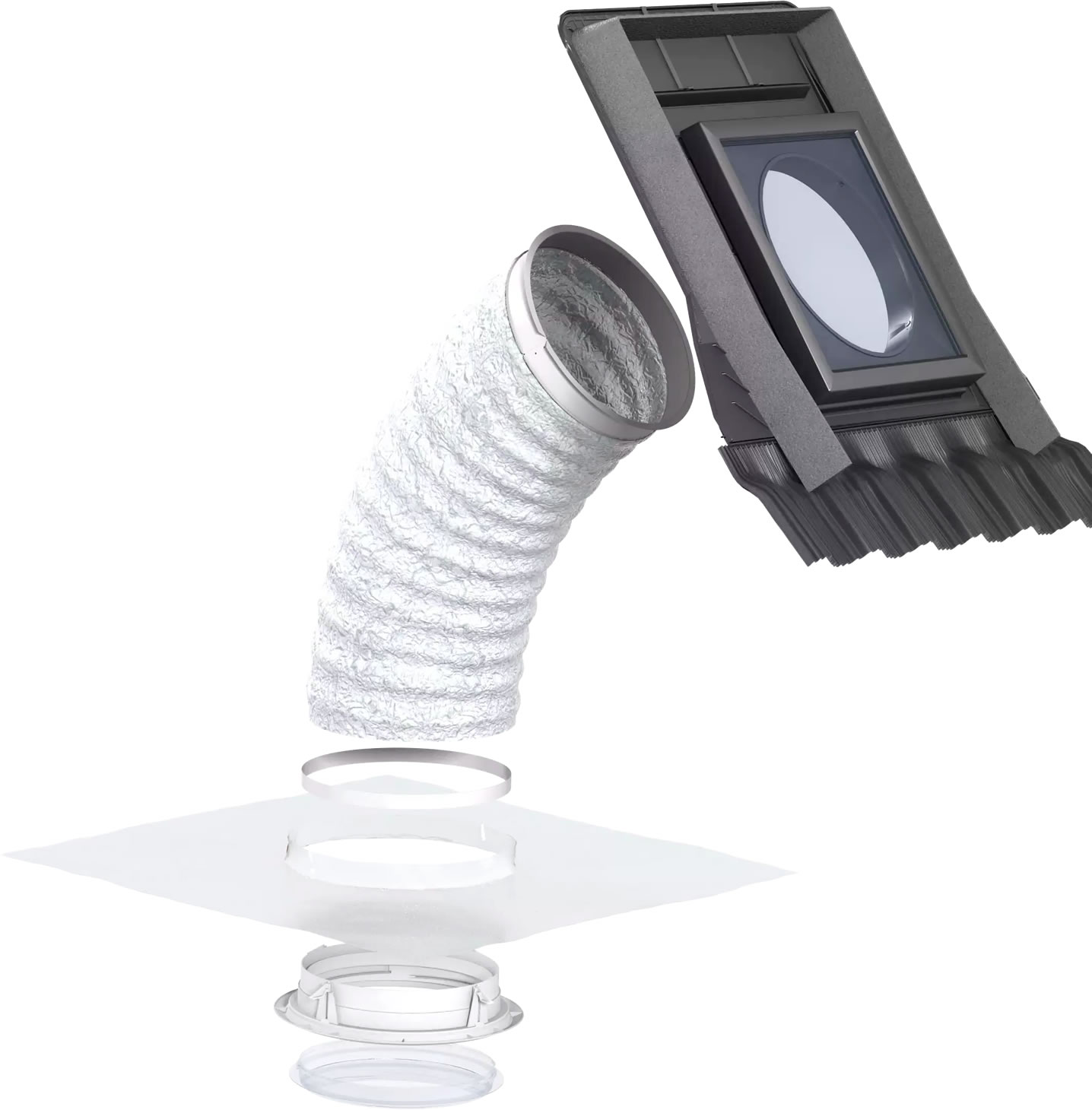
A sun tunnel can bring natural daylight into a dark hallway, bathroom, landing or internal room where a conventional window would not work. However, choosing the right system involves more than selecting the best-known brand.
The roof covering, tunnel length, number of bends and size of the room all affect the result. In addition, some models suit tiled roofs, while others work with slate, profiled coverings or flat roofs. A model that performs brilliantly through a short, straight route may prove disappointing when connected to a long flexible tube with several bends.
The main sun tunnel brands available to UK homeowners include:
- VELUX
- FAKRO
- Monodraught SUNPIPE
- Keylite Sunlite
- Solatube
- LiteLight and other specialist daylight-tube systems
For most standard domestic installations, VELUX provides the strongest all-round choice because it offers rigid and flexible systems for pitched and flat roofs, widely available accessories and strong installer familiarity. Meanwhile, FAKRO offers an excellent alternative, particularly where homeowners want a highly reflective rigid tube or need a system for a specific roof covering. Monodraught and Solatube tend to suit more specialist or performance-led projects.
Best sun tunnel brands at a glance
| Brand | Best For | Main Strength | Possible Drawback |
|---|---|---|---|
| VELUX | Best all-round domestic option | Broad range, familiar installation and widely available parts | Premium price compared with some alternatives |
| FAKRO | Best VELUX alternative | Strong rigid-tube performance and varied roof options | Fewer installers may know the range as well |
| Monodraught SUNPIPE | Larger or specialist daylight projects | Broad size options and established daylighting focus | May cost more and feel excessive for a small hallway |
| Keylite Sunlite | Value-focused domestic installation | Competitively priced pitched and flat-roof kits | Smaller product ecosystem than VELUX |
| Solatube | Premium daylight performance | Specialist optical components and high-performance positioning | Higher installed cost and less widespread UK availability |
| LiteLight | Budget or straightforward applications | Simple daylighting products at accessible prices | Fewer premium accessories and less brand recognition |
Which brand is best overall?
For the average UK homeowner, VELUX is usually the safest all-round choice.
VELUX offers sun tunnels for pitched roofs between 15 and 60 degrees, as well as separate models for flat roofs between 0 and 15 degrees. The range includes rigid and flexible tubes in 25cm and 35cm sizes. Therefore, it covers most conventional domestic situations, including tiled roofs, slate roofs, flat extensions and routes with loft obstructions.
However, “best” depends on the installation:
- Choose VELUX for the broadest all-round domestic solution.
- Choose FAKRO when rigid-tube reflectivity and roof-covering choice matter.
- Choose Monodraught SUNPIPE for larger, specialist or design-led projects.
- Consider Keylite when price matters and a suitable kit matches the roof.
- Consider Solatube for a premium daylighting specification.
- Consider LiteLight for a straightforward, budget-led installation.
VELUX sun tunnels
VELUX is probably the best-known sun tunnel brand among UK homeowners and roofing contractors. Its main strength lies in the complete system rather than one isolated feature.
The range includes:
- rigid and flexible tunnels
- pitched-roof models
- flat-roof models
- 25cm and 35cm diameters
- tube extensions
- optional electric light kits
- a ventilation outlet accessory for compatible 35cm pitched-roof models
This accessory range can make future alterations easier. For example, homeowners can add a low-energy light kit so the diffuser also works as a ceiling light at night. Compatible pitched-roof models can also use a ventilation outlet kit connected to a separate extractor fan.
VELUX TWR rigid sun tunnel
The VELUX TWR is a rigid-tube model for pitched roofs with profiled coverings such as many concrete or clay tiles.
The model name generally breaks down as:
- T – sun tunnel
- W – pitched-roof application with profiled covering
- R – rigid tube
A common domestic option is the TWR 0K14, which uses a 35cm tunnel. Smaller 25cm versions may suit compact areas, while the 35cm model usually provides the better choice for larger hallways, landings and bathrooms.
A rigid tube transfers light more efficiently than a flexible one, particularly when the route remains short and reasonably straight. VELUX says that a 35cm rigid model installed under favourable average conditions can provide light comparable to a conventional 60W bulb, although actual daylight changes with weather, orientation, tube length and roof pitch.
Best suited to:
- tiled pitched roofs
- short or medium straight routes
- homeowners prioritising daylight output
- hallways, landings and internal bathrooms
Main advantage: Better light transmission than a flexible model.
Main limitation: The rigid sections need enough space around rafters, tanks, pipes and other obstructions.
VELUX TLR rigid sun tunnel
The VELUX TLR provides a rigid-tube option for pitched roofs with flat roofing materials, such as certain slate applications.
The product works on the same basic principle as the TWR. However, the roof component and flashing suit a flatter roof covering.
Best suited to:
- slate roofs
- flat-profile pitched-roof coverings
- straight routes through the loft
- installations where light performance takes priority
An installer must confirm compatibility with the exact slate or roof covering rather than selecting a model from the word “slate” alone.
VELUX TWF flexible sun tunnel
The VELUX TWF uses a flexible tunnel for pitched roofs with profiled coverings.
A flexible tube helps the installer route the system around:
- rafters
- water tanks
- pipes
- cables
- loft platforms
- other fixed obstacles
Therefore, the TWF can make an otherwise awkward installation possible. Nevertheless, the bends and textured inner surface usually reduce light transmission compared with a rigid tube.
Best suited to:
- tiled pitched roofs
- short routes with obstructions
- crowded loft spaces
- installations where a rigid tube will not fit
Main advantage: Easier routing around loft obstructions.
Main limitation: Usually delivers less daylight than an equivalent rigid system.
VELUX TLF flexible sun tunnel
The VELUX TLF combines a flexible tube with a roof unit intended for flat-profile pitched coverings.
It offers similar installation flexibility to the TWF but suits roofs where the relevant flat-covering flashing arrangement applies.
Best suited to:
- slate and other compatible flat roof coverings
- short, obstructed routes
- rooms where moderate daylight improvement is sufficient
VELUX TCR rigid flat-roof sun tunnel
The VELUX TCR provides a rigid-tube option for flat roofs.
It usually makes the most sense where the room sits beneath a flat-roof extension and the installer can form a fairly direct route between the roof and ceiling.
Best suited to:
- flat-roof extensions
- kitchens and utility rooms
- short, direct installations
- homeowners who want stronger daylight performance
VELUX TCF flexible flat-roof sun tunnel
The VELUX TCF uses a flexible tube and a flat-roof roof unit.
It can help where joists, services or other obstructions stop the installer from creating a straight route. However, as with other flexible tunnels, the easier installation comes with some reduction in light delivery.
Best suited to:
- flat roofs with awkward voids
- routes that need one or more bends
- small rooms where maximum brightness is not essential
Which VELUX model should you choose?
| Roof and Route | VELUX Model to Consider |
| Pitched tiled roof with a straight route | TWR rigid |
| Pitched slate or flat-profile roof with a straight route | TLR rigid |
| Pitched tiled roof with obstructions | TWF flexible |
| Pitched slate or flat-profile roof with obstructions | TLF flexible |
| Flat roof with a straight route | TCR rigid |
| Flat roof with an obstructed route | TCF flexible |
The roofer should still check the full product suffix because it identifies the tunnel diameter, roof-covering application and specification.
FAKRO light tunnels
FAKRO provides one of the strongest alternatives to VELUX. Its range includes rigid and flexible models for pitched and flat roofs, along with versions intended for slate, tiled, profiled and standing-seam coverings.
A major strength of the rigid FAKRO SRT range is the reflective aluminium tube. FAKRO states that the inner surface uses a silver-based reflective layer with reflectivity of up to 98%. Consequently, the rigid models make a strong choice where homeowners want to preserve as much daylight as possible through the tube.
FAKRO SRT rigid light tunnel
The FAKRO SRT family uses rigid reflective sections. The complete model code then varies according to the roof covering.
Common versions include models for:
- tiled and profiled roofs
- slate roofs
- flat roof coverings
- sheet metal and standing-seam applications
The rigid tube works best through a reasonably direct route. Extension sections and elbows allow an installer to lengthen or adjust it where required.
Best suited to:
- homeowners prioritising light delivery
- straight or gently angled routes
- medium or longer tunnel runs
- roofs needing a more specific flashing choice
FAKRO SRL rigid light tunnel for slate roofs
The FAKRO SRL is a rigid-tube model intended for slate roof applications.
It can provide a useful alternative to a VELUX TLR, particularly where the installer regularly works with FAKRO products or where the FAKRO flashing better matches the roof specification.
Best suited to:
- natural or compatible slate roofs
- installations needing a rigid high-reflectivity tube
- period or traditional homes with dark central spaces
FAKRO SRZ rigid light tunnel
The FAKRO SRZ range serves certain profiled or corrugated coverings.
As always, the installer must match the complete flashing and roof element to the actual material rather than relying on a shortened product name.
FAKRO flexible light tunnels
FAKRO also supplies flexible-tube systems for locations where a rigid run would prove difficult. These systems make routing easier, although they generally sacrifice some daylight performance.
FAKRO offers extension elements for flexible systems, with lengths available in set increments. However, extending any flexible tunnel too far can reduce the final light level, so the installer should assess likely performance before recommending it.
FAKRO flat-roof models
FAKRO offers rigid and flexible light tunnels for flat roofs between 0 and 15 degrees. Its flat-roof system uses a roof unit based on its established type-C flat-roof window design with a protective dome.
The FAKRO SR_ rigid flat-roof range includes reflective tube sections, elbows, a ceiling frame and a prismatic diffuser. Some configurations provide around 2.1 metres of tube in the standard kit, although the exact contents vary by size and model.
The FAKRO SF_ flexible flat-roof range typically includes a flexible tube, roof element, diffuser and installation components.
VELUX or FAKRO: which is better?
Both brands offer credible domestic systems.
| Feature | VELUX | FAKRO |
| UK brand recognition | Excellent | Good |
| Installer familiarity | Excellent | Good |
| Rigid and flexible options | Yes | Yes |
| Pitched and flat-roof systems | Yes | Yes |
| Roof-covering choices | Broad | Particularly broad |
| Accessories and replacement availability | Excellent | Good |
| Standout strength | Complete domestic ecosystem | Highly reflective rigid tube |
| Best for | Most standard homeowners | Performance- or specification-led alternatives |
Choose VELUX when you value installer familiarity, widespread availability and a broad accessory ecosystem.
Choose FAKRO when the roof covering calls for a particular FAKRO configuration or when a high-reflectivity rigid-tube specification appeals.
Monodraught SUNPIPE
Monodraught specialises in natural daylighting and ventilation rather than treating sun tunnels as a small part of a broader roof-window range.
Its SUNPIPE systems channel daylight through reflective tubes into internal rooms. The range has appeared in domestic, education, retail and commercial settings, so it can suit larger or more design-led applications as well as homes.
Strengths of SUNPIPE
- specialist daylighting focus
- multiple system diameters
- pitched- and flat-roof configurations
- potential suitability for larger spaces
- options for more complex or performance-led projects
- established use in non-domestic buildings
Possible drawbacks
- higher supply and installation cost
- more system than a small cupboard or landing may need
- fewer domestic roofers may stock it as a routine product
- specification may require more specialist input
Best SUNPIPE application
SUNPIPE makes particular sense for:
- larger hallways
- open-plan extensions
- schools and offices
- communal corridors
- commercial premises
- homes where the owner wants a specialist daylight design
For a small upstairs landing, VELUX or FAKRO may offer a simpler route. However, for larger areas or projects where daylight calculations matter, SUNPIPE deserves consideration.
Keylite Sunlite
Keylite supplies the Sunlite range for pitched and flat roofs. Available kits include different diameters, roof types and flexible tube lengths.
Keylite can appeal to homeowners who want a recognised roof-window manufacturer but are looking for a competitively priced alternative to the largest brands.
Keylite Sunlite strengths
- pitched- and flat-roof kits
- various tube diameters
- competitively priced options
- availability through UK roofing merchants
- suitable for straightforward domestic projects
Keylite Sunlite limitations
- fewer accessories than the widest VELUX ecosystem
- installers may have less experience with it
- some commonly sold kits use flexible tubes, which may deliver less light than rigid alternatives
Models worth considering
A 350mm pitched-roof Sunlite kit can suit an upstairs hallway, bathroom or landing. Meanwhile, a larger 450mm flat-roof kit may suit an extension or a room that needs more daylight.
Before choosing the larger diameter, the installer should check available space between joists and rafters.
Solatube daylighting systems
Solatube is a specialist tubular daylighting brand often positioned toward the premium end of the market.
The range is known for optical roof collectors, highly reflective tubing and diffusers designed to distribute daylight effectively. However, UK availability and installer coverage can prove more limited than VELUX.
Common residential lines internationally include the Solatube 160 DS and Solatube 290 DS, although homeowners should confirm current UK availability, roof kits and warranties before specifying a model.
Solatube 160 DS
The 160 DS is generally the smaller residential model. It can suit:
- bathrooms
- small hallways
- dressing rooms
- compact landings
- utility rooms
Solatube 290 DS
The larger 290 DS can suit:
- bigger hallways
- kitchens
- living areas
- larger internal rooms
- spaces requiring more daylight
Solatube strengths
- premium daylighting focus
- specialist optical design
- broad accessory potential
- suitable for performance-led projects
Solatube drawbacks
- higher purchase and installation price
- fewer routine UK stockists
- smaller pool of experienced installers
- replacement parts may not prove as locally accessible
Solatube can provide an excellent system, but homeowners should compare the performance gain with the added cost and local support.
LiteLight sun tunnels
LiteLight systems generally target straightforward and value-led daylighting projects.
They may suit homeowners who want to brighten a small internal room without paying for the most feature-rich premium system.
Advantages
- accessible pricing
- simple product choices
- suitable for straightforward routes
- possible option for garages, corridors and utility areas
Disadvantages
- fewer accessories
- less brand recognition
- smaller installer and replacement-part network
- performance information may prove less detailed
- fewer specialised roof-covering options
The product can still perform well when the installer chooses the correct diameter and creates a short, direct route. However, a cheap flexible kit will not usually match the output of a premium rigid system through the same space.
Best sun tunnel by application
| Application | Recommended Brand or Model |
| Best all-round pitched tiled-roof system | VELUX TWR 35cm rigid |
| Best for a tiled roof with obstructions | VELUX TWF flexible |
| Best for a slate roof with a straight route | VELUX TLR or FAKRO SRL rigid |
| Best rigid-tube alternative to VELUX | FAKRO SRT range |
| Best all-round flat-roof option | VELUX TCR rigid |
| Best flat-roof option with obstructions | VELUX TCF or FAKRO flexible flat-roof model |
| Best specialist daylighting system | Monodraught SUNPIPE |
| Best premium performance-led choice | Solatube |
| Best value-led established alternative | Keylite Sunlite |
| Best for a small budget project | LiteLight or suitable merchant-brand system |
Rigid or flexible: the model choice that matters most
Brand matters, but tube type often has a bigger effect on performance.
Choose a rigid sun tunnel when:
- the route is reasonably straight
- maximum daylight matters
- the tunnel must run more than a short distance
- the roof space has enough clearance
- elbows can handle any minor change in direction
Choose a flexible sun tunnel when:
- rafters or services block a straight route
- the route is short
- installation simplicity matters more than maximum brightness
- the room only needs a modest daylight improvement
Where either type will fit, a rigid model generally makes the stronger choice.
What size sun tunnel should you choose?
The most common domestic diameters are approximately 25cm and 35cm, although specialist brands offer larger sizes.
| Diameter | Typical Application |
| Around 25cm | Small bathroom, cupboard, short corridor or compact landing |
| Around 35cm | Standard hallway, landing, kitchen area or medium internal room |
| 45cm and above | Larger rooms, commercial areas or specialist projects |
A larger tube can collect and carry more daylight. However, it also needs a larger roof and ceiling opening. The installer must check rafter spacing, joists, roof covering and diffuser position before recommending the size.
Factors that matter more than the logo
Choosing the most expensive brand does not guarantee the brightest room. In practice, the following details often matter more:
Roof orientation
A roof surface with good exposure to daylight generally provides better performance than one heavily shaded by trees or neighbouring buildings.
Tunnel length
Shorter routes usually deliver more light.
Number of bends
Each bend can reduce light transmission. Therefore, the installer should avoid unnecessary turns.
Tube type
Rigid mirrored tubing normally outperforms flexible tubing.
Diameter
A larger diameter generally delivers more light, provided the roof and ceiling can accommodate it.
Roof collector position
A poorly positioned collector can underperform even when connected to a premium tube.
Installation quality
Gaps, damaged reflective surfaces, poor seals and badly formed joints can all reduce performance or cause condensation and leaks.
Typical sun tunnel product and installation costs
The product kit forms only part of the total. Homeowners must also budget for roof labour, internal fitting, access and making good.
| Product or Installation | Typical Guide Price |
| Standard domestic sun tunnel kit | £300 to £650+ |
| Larger or premium kit | £600 to £1,200+ |
| Straightforward professional installation | £600 to £1,200 total |
| Premium or complex installed system | £1,200 to £2,500+ |
| Flat-roof installation | £1,200 to £2,800+ |
| Scaffolding or specialist access | Usually extra |
| Plastering and decorating | Sometimes extra |
Prices vary considerably by brand and specification. Current VELUX UK pages list pitched-roof sun tunnels from approximately £478 and flat-roof versions from approximately £577 before installation, although model, diameter and options affect the final product price.
What should you ask an installer?
Before accepting a quote, ask:
- Which brand and full model code have you specified?
- Is the tube rigid or flexible?
- What diameter will it be?
- How long will the complete tunnel be?
- How many bends will it need?
- Does the roof kit match my tiles, slates or flat-roof covering?
- Are extensions and elbows included?
- Does the price include internal making good?
- Will you insulate and seal the tube?
- Is scaffolding included?
- What product and workmanship guarantees apply?
- Can replacement diffusers and accessories be sourced later?
A quote that only says “fit one sun tunnel” does not provide enough detail for a fair comparison.
Which sun tunnel brand should you choose?
For most UK homes, the following shortlist provides a sensible starting point:
- Best overall: VELUX
- Best direct alternative: FAKRO
- Best specialist system: Monodraught SUNPIPE
- Best value-led option: Keylite Sunlite
- Best premium daylighting option: Solatube
- Best budget option: LiteLight or another well-specified basic kit
However, the best model is the one that matches the roof covering and allows the shortest, straightest practical route.
A correctly selected FAKRO or Keylite system can outperform an unsuitable premium model. Likewise, a rigid 35cm tunnel can deliver a much better result than a small flexible tube from the same brand.
Get sun tunnel installation quotes
A professional installer can inspect the roof, identify a suitable route and recommend a brand, diameter and tube type that fit the property.
Use the quotation form on this page to compare sun tunnel installation quotes from local specialists. Ask each installer to identify the exact brand and model so that you can compare like with like.
Frequently asked questions
What is the best sun tunnel brand in the UK?
VELUX is usually the best all-round choice for a standard UK home because it offers rigid and flexible systems for pitched and flat roofs, along with widely available accessories. However, FAKRO, Monodraught, Keylite and Solatube may suit specific projects better.
Which VELUX sun tunnel is best for a tiled roof?
A VELUX TWR rigid sun tunnel usually offers the best performance where a straight route is available through a tiled pitched roof. Where rafters or services obstruct the route, a TWF flexible model may fit more easily.
Which sun tunnel is best for a slate roof?
A VELUX TLR or FAKRO SRL rigid system can suit many slate-roof installations. The installer must confirm that the flashing and roof element match the exact slate type and roof pitch.
Is FAKRO as good as VELUX?
FAKRO offers credible rigid and flexible systems and can provide excellent daylight performance. Its rigid SRT range uses a highly reflective inner surface. However, VELUX products and accessories may prove easier to source through local UK merchants.
Is a rigid sun tunnel better than a flexible one?
A rigid tunnel normally delivers more daylight because its smooth reflective surface loses less light. A flexible tunnel is easier to route around obstructions but usually produces a lower output.
Is Solatube worth the extra money?
Solatube can suit homeowners who want a premium, performance-led daylighting system. However, the extra cost may not make sense for a small hallway where a well-positioned VELUX or FAKRO rigid tunnel would already provide a good result.
Are Keylite sun tunnels good?
Keylite Sunlite kits can provide a good value option for straightforward domestic installations. However, homeowners should compare the tube diameter, length and type rather than choosing on kit price alone.
Which sun tunnel is best for a flat roof?
A VELUX TCR rigid flat-roof model offers a strong all-round option where the route is direct. A VELUX TCF or comparable FAKRO flexible model may suit an obstructed route.
What size sun tunnel should I buy?
A 25cm tunnel may suit a small bathroom or compact landing. A 35cm model often works better in a standard hallway or medium internal room. Larger areas may need a wider specialist system or more than one tunnel.
Can I mix sun tunnel parts from different brands?
Generally, no. Roof units, tubes, elbows, diffusers and accessories form part of a tested system. Installers should use compatible components from the same manufacturer unless the manufacturer specifically approves another arrangement.