

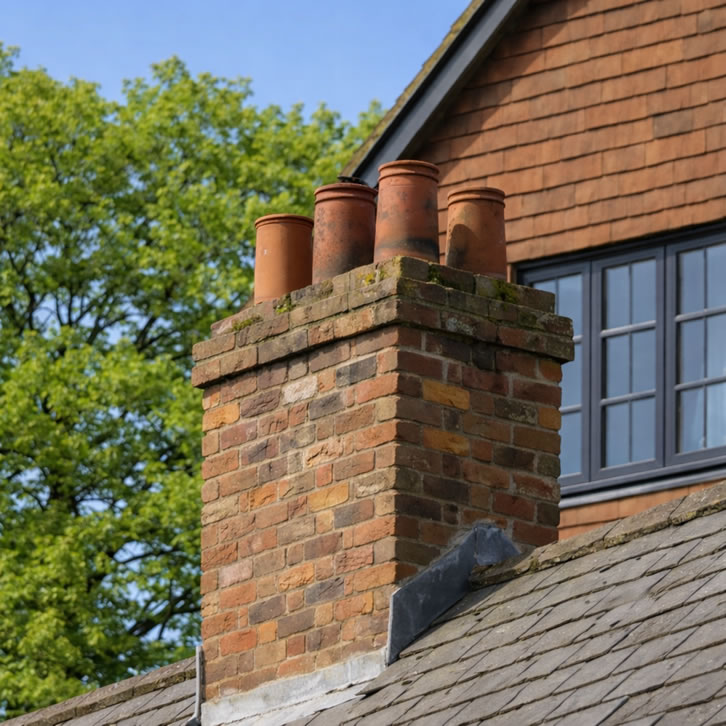
Most chimney problems don’t start with a dramatic collapse or a sudden waterfall through the ceiling. They start small: a hairline crack in the flaunching, mortar joints that have softened, or leadwork that’s lifted just enough for wind-driven rain to creep in.
This post is designed to be completely different to the usual chimney repair guides. Instead of focusing on “what is repointing?” it gives you a maintenance-led plan: what to check, when to check it, how to prioritise repairs, and how to avoid paying twice for the same issue.
Why chimneys fail more than other roof areas
Chimneys are exposed on all sides and often sit above the warmest part of a house. That creates a perfect storm of wear:
-
Wind and rain hit a chimney harder than sheltered walls
-
Freeze–thaw cycles expand cracks in mortar and flaunching
-
Warm air from the flue meets cold outdoor air, encouraging damp/condensation if ventilation is poor
-
Roof junctions (flashings/tiles) are a natural weak point
-
Past “repairs” done with the wrong materials can trap moisture and accelerate damage
The UK chimney maintenance calendar (what to check and when)
If you want fewer emergencies, this is the simplest routine.
| Time of year | What to check | Why it matters |
|---|---|---|
| Spring (after winter) | Mortar joints, brick faces, flaunching, pots/cowls | Frost damage shows up after cold weather |
| Summer | Any repointing/rebuild planning | Better drying conditions for mortar work |
| Autumn (before storms) | Flashings, back of chimney, cowls, gutters nearby | Prevent wind-driven rain leaks in storm season |
| After a storm | Loose pots, new cracks, debris below | Quick action prevents accidents and water ingress |
Quick win: even if you do nothing else, check the top of the stack (pots/cowls/flaunching) and the roof junction (flashing/tiles) each year.
“Fix first” priority list (what stops damage fastest)
Not all chimney repairs have equal impact. Use this order to decide what to tackle first.
| Priority | Issue | Why it’s urgent |
|---|---|---|
| 1 | Loose pots / unstable brickwork | Safety risk + falling debris |
| 2 | Flashing failure at roof junction | Fastest route to ceiling/loft leaks |
| 3 | Cracked flaunching / no cowl | Water entry from the top accelerates decay |
| 4 | Failed repointing / open joints | Moisture soaks stack → spalling bricks |
| 5 | Cosmetic staining/efflorescence | Often a symptom, not the cause |
Chimney repair types — mapped to maintenance symptoms
Instead of listing repairs, this links them to what you’d actually notice.
| What you notice | Likely cause | Typical repair |
|---|---|---|
| Damp near chimney breast after heavy rain | Flashing/tiles at junction | Flashing repair or renewal + tile check |
| Damp that lingers even in dry weather | Porous brickwork / failing mortar | Repointing + replace damaged bricks |
| Water marks directly below pots | Cracked flaunching or poor cowl | Flaunching repair + pot/cowl work |
| Birds nesting / noise in flue | No bird guard | Bird-guard cowl fitted |
| White salts on chimney bricks | Moisture moving through masonry | Address water entry point + breathable repairs |
Repointing isn’t always the same job (cement vs lime mortar)
One reason chimney repairs fail is incompatible mortar.
| Mortar type | Where it’s commonly used | Pros | Watch-outs |
|---|---|---|---|
| Cement-based | Many modern homes | Strong, common, familiar to many contractors | Can be too hard for older bricks; may trap moisture |
| Lime mortar | Many older/period properties | More breathable; flexible; kinder to older bricks | Needs correct mix and curing; should be done properly |
If you’ve got an older property and your chimney bricks are soft or spalling, it’s worth asking what mortar is being proposed and why.
Prevention upgrades that reduce future chimney repairs
These aren’t “repairs”, but they can massively reduce repeat call-outs.
1) A suitable chimney cowl
-
Helps reduce rain entry
-
Can improve downdraught issues
-
Bird guards reduce nesting problems
2) Good ventilation for unused chimneys
Unused flues can develop damp and odours. Many homeowners benefit from a vented approach that reduces rain entry while allowing airflow (your roofer can advise on the right setup).
3) Fix nearby guttering and overflow
Overflowing gutters can soak chimney brickwork and speed up mortar failure. Sometimes the “chimney damp” is actually gutter overflow nearby.
Quote comparison: the “what’s included?” table homeowners wish they had
Use this to avoid quotes that sound cheap but exclude critical parts.
| Item | Should it be clear in the quote? | Why it matters |
|---|---|---|
| Access method (ladder/roof ladder/scaffold) | Yes | Safety + quality of workmanship |
| Repair scope (which faces/areas) | Yes | “Repoint chimney” can mean anything |
| Flashing included or excluded | Yes | Flashing is a common leak point |
| Brick replacement allowance | Yes | Spalled bricks need replacing, not just pointing |
| Pots/cowls/flaunching included | Yes | Top-of-stack leaks are common |
| Waste removal | Yes | Avoid surprise skip hire charges |
| Photos of completed work | Ideal | Helpful if chimney isn’t visible from ground |
| Guarantee details | Yes | Ensure it covers the relevant work |
Typical timescales (so you can plan around it)
| Job type | Typical on-site time (guide) | Notes |
|---|---|---|
| Cowl/pot/flaunching work | Half-day to 1 day | Access drives this |
| Flashing repairs | 1 day | Often paired with tile checks |
| Repointing a typical stack | 1–2 days | Weather dependent |
| Partial rebuild (top section) | 1–3 days | More if scaffold and complex roofline |
When chimney repairs become urgent
Book an inspection quickly if you see any of the following:
-
chimney pot looks loose, tilted, or missing
-
large cracks through brickwork (not just mortar joints)
-
bulging/leaning stack
-
chunks of mortar/bricks falling
-
sudden worsening of leaks after storms
What to include in a chimney repair quote request (to get better pricing)
If you want faster, more accurate quotes, include:
-
postcode area and property type (house/flat)
-
number of storeys
-
what you’ve noticed (leaks, loose mortar, pot movement, etc.)
-
when it happens (windy rain / heavy rain / constant damp)
-
photos from ground or upstairs window (only if safe)
-
anything that affects access (conservatory below, narrow alley, etc.)
FAQs: chimney repairs (UK maintenance angle)
How often should a chimney be inspected?
A simple annual visual check is a good baseline, plus a quick check after major storms.
Why do chimney repairs fail after a couple of years?
Common reasons include patch repairs that don’t address the water entry point, incorrect flashing details, or mortar that isn’t suitable for the brick type.
Do cowls really make a difference?
For many homes, yes — especially for rain entry, downdraught, and birds nesting. The right type depends on your chimney and whether it’s in use.
Is internal damp always caused by external leaks?
Not always. Unused chimneys can suffer from airflow/condensation issues as well as rain entry. A roofer can help determine the source.
What’s the best time of year for repointing?
Generally, milder, drier conditions are better for mortar work, because curing is more reliable.